
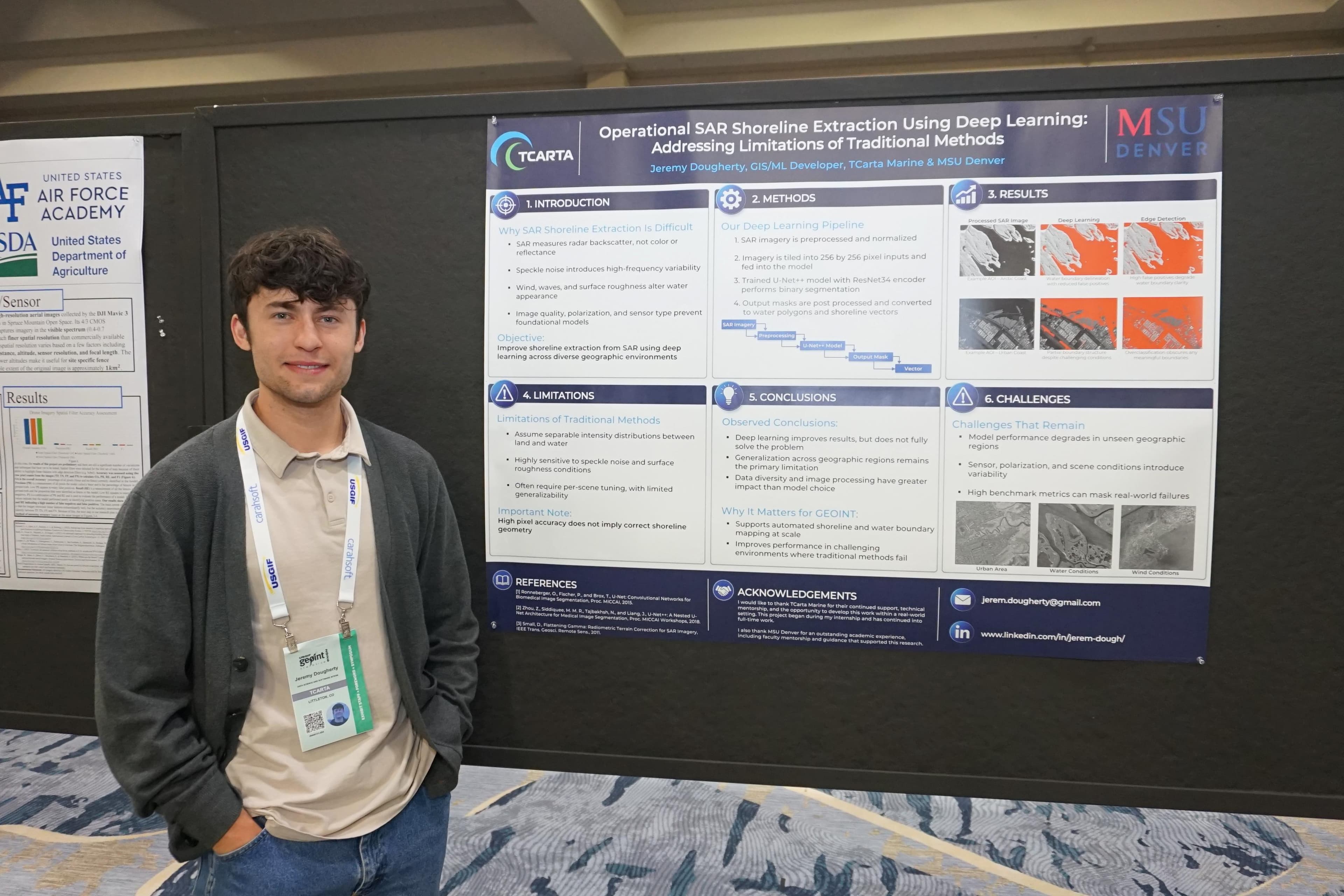
Congratulations to TCarta’s newest Software Developer, Jeremy Dougherty for taking 3rd place at the GEOINT’s Poster Competition! Jeremy represented both TCarta and Metropolitan State University of Denver with his outstanding research on "Operational SAR Shoreline Extraction Using Deep Learning." We’re proud to see his hard work and innovation recognized alongside the community's brightest minds. Great job, Jeremy!
Abstract:
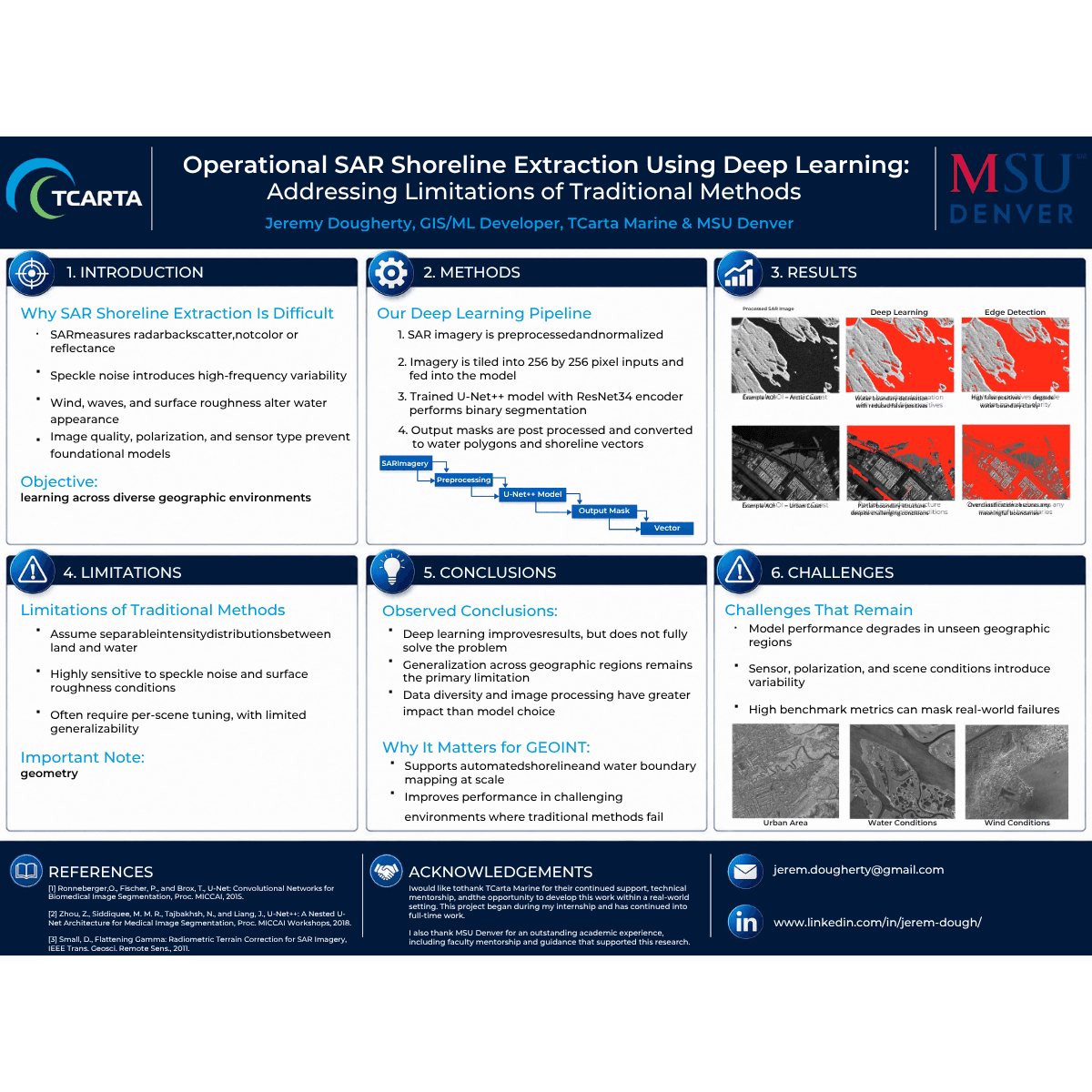
Operational SAR Shoreline Extraction Using Deep Learning
Accurate shoreline delineation from Synthetic Aperture Radar (SAR) imageryis a critical task for coastal monitoring, environmental intelligence, andgeospatial analysis, yet remains challenging due to speckle noise, inlandwater misclassification, and regional variability. Traditional threshold-basedSAR shoreline extraction methods can perform well along open coastlines, butoften overclassifies inland water bodies and requires extensive manualpost-processing to produce usable results. This poster presents an operationaldeep learning–based shoreline extraction pipeline designed to address theselimitations while maintaining repeatability and scalability across diversegeographic regions.
The proposed approach integrates a fully automated SAR preprocessing andbatch-processing workflow with a convolutional neural network segmentationmodel trained on Capella SAR imagery. The current model architecture is basedon a U-Net++ framework with a ResNet34 encoder, producing binary water/non-watersegmentation from 256×256 RGB SAR tiles. The training dataset consists of nearly40,000 image–label pairs collected across tropical, temperate, and Arctic coastalenvironments, with geographically separated training and validation regions toassess model generalization.
Preliminary results demonstrate that deep learning methods can outperformtraditional binary thresholding in complex coastal environments, particularlywhere inland water and shoreline morphology confound classical approaches.However, results also highlight key operational challenges, including reducedperformance in unseen geographic regions and the limitations imposed byout-of-the-box model architectures and preprocessing tools. These findingsemphasize the importance of domain-specific training data, a flexible modeldevelopment environments, and rigorous validation strategies when applying AIto SAR-based GEOINT workflows.
This work contributes a transparent assessment of what currently works, whatdoes not, and why, providing insight into how deep learning can be responsiblyintegrated into operational SAR shoreline extraction pipelines. The posteremphasizes practical lessons learned from real-world deployment, offeringguidance for the future development of a scalable, generalizable SAR-based shorelineintelligence products.