• Skip to primary navigation
  • Skip to main content
TCarta Satellite-Based Hydrospatial Tech

TCarta Satellite-Based Hydrospatial Tech

We are your contact for Marine Remote Sensing and Hydrospatial data services.

  • Who We Are
    • About
    • Partnerships & Affiliations
  • What We Do
    • What is Hydrospatial?
    • What Do We Measure?
    • How to Work with TCarta
  • Products & Services
    • Products
      • Global Bathymetry GIS
      • Satellite-Derived Bathymetry
      • Seafloor Classification
      • Newsletter Archive
      • Marine Basemaps
    • Services
      • Blue Carbon Mapping
      • Synthetic Aperture Radar (SAR)
      • Satellite-Derived Water Quality
      • Trident Tools Satellite-Derived Bathymetry Software
    • Custom Solutions
  • Case Studies
    • Space-based Hydrospatial Solutions for Engineering Projects in the Littoral Zone
    • Technology Demonstration Project: Large-Scale Satellite Derived Bathymetry Mapping
    • Hydrographic Office Technology Integration
    • Updating Information on Nautical Charts in Baffin Island, Canada
  • News & Press
    • Newsroom
    • Blogs
  • Product Viewer
  • Contact
  • Show Search
Hide Search

Amy Anfinrud

Celebrate Hydrography by Uplifting and Enabling the Modern Hydrographer

Amy Anfinrud · June 9, 2025 ·

Satellite Mapping Products include SDB (left) and Satellite Reconnaissance Charts (middle)

Domestically and internationally, the turn of events is mercurial, unpredictable at best. Government agencies, markets and industries are compelled to change, and established professional pathways are currently obscured or threatened. Decision-makers have reason to hesitate and resources are consequently delayed. The maritime industry and hydrographic and geospatial professions are not immune. Yet, coastal awareness and hydrographic information are relentlessly relevant and in-need of curation and maintenance. 

Now more than ever, satellite based solutions and capabilities are essential for the safe-keeping of nations and environments and for the evolution of hydrography and hydrographers.

Esteemed universities and forward-leaning international hydrographic offices uptake satellite mapping as an additional tool in a hydrographers’ toolbelt, sustaining young professionals’ drive to stay at the front of modern technology. The suite of satellite mapping technologies are deployed globally to generate insights for shallow water environments and to put actionable, modern data into the hands of those who need it for the sake of environmental management, national security and/or maritime safety. 

Satellite derived mapping leverages multispectral satellite imagery for information on shallow water environments including depth, bottom type, tides, and shoreline, to name a few. For years, remote sensing students have deployed the GEBCO cookbook or other open source approaches to achieve results in shallow water environments. With a satellite image and the right tools, anyone with a basic understanding of remote sensing and GIS can achieve a result, the first building block of producing actionable, reliable bathymetric information from satellites.

Traditional surveys are expensive, logistically complex, and often out of reach for many nations. Satellite methods deliver usable, accurate data at a fraction of the cost and time, expanding accessibility to critical hydrographic information. This enables governments to map coastlines, support disaster resilience, and evolve their Blue Economies with better data, fostering sustainable development.

With experience and training, an analyst from anywhere in the world can process a high-resolution satellite image collected yesterday over Oman’s coast, or a bay in Alaska, to deliver usable bathymetric information in just a few hours. Tomorrow’s mission can be planned today with modern hydrographic information in focus. 

With experience and training, in a matter of days, an analyst can process a satellite image from 10 years ago, 5 years ago, and one from this year to quantify the presence of seagrass along the coast of their home country. How has the nation’s environmental asset of seagrass fared over the last 10 years? Satellite mapping this seagrass can effectively quantify and visualize these initiatives.  Environmental management priorities and plans can be informed by desktop workflows and products without deployment of costly planning and survey.

Habitat Mapping in the Red Sea | Left: RGB Satellite Image; Right-Seafloor Classification

When equipped with the proper tools and expertise, an analyst in a small hydrographic office can deploy satellite mapping ahead of a SBES or MBES collection with particular attention to shoal and no-go areas to ensure safety of equipment and efficiency of the survey. Once home from survey, the two data sets (satellite-based and vessel-based) can be used to improve each other. Optimal bathymetric information is achieved by technology integration.

Satellite-derived hydrography is beneficial for reconnaissance and planning, infilling data gaps or mapping the ‘white ribbon’. It’s fast, repeatable, and scalable, environmentally-friendly, and more affordable than traditional surveys. It is not a replacement for traditional methods but a vital tool in today’s world where geographic hotspots are remote and often contested and time is of the essence.  The modern hydrographer’s toolbox should include satellite-based mapping in order to fill gaps in understanding, answer questions quickly, and advance programs regardless of budget constraints.

Enabling the Hydrographers of Today and Tomorrow

TCarta has delivered SDB trainings to international university students and hydrographic offices including the Mexican Navy, Jamaican National Land Agency, University of Southern Mississippi Cat A Program, Dominican Republic Navy, Marine and Fisheries Institute of University of Newfoundland, the Fiji Hydrographic Office, University of Southern Florida and GEBCO Scholars of University of New Hampshire’s Center of Coastal and Ocean Mapping.

SDB Training provided by TCarta with the Mexican Navy

Future and current professionals benefit from customized programs that enable agencies to create and manage their own bathymetric datasets. This is possible with the support from partners like GEBCO, Nippon Foundation, and Seabed 2030. Internship programs, such as the program TCarta co-runs with Marine Institute and Seabed 2030 (now in its 3rd year), provide hands-on experience in space-based coastal mapping, and real-world training with SDB tools and workflows ensures practitioners gain the skills needed for modern hydrographic work.

SDB training by TCarta with the Armada de la República Dominicana
TCarta’s President Kyle Goodrich after leading an SDB workshop at the Fiji Hydrographic Office

At TCarta, we understand that no two hydrographic teams are the same, so we tailor our training to meet your operational goals and technical needs. Our SDB course can range from 2-days to 2-weeks, and can be either an in-person or virtual program that walks participants through the workflow: from satellite image preprocessing to machine learning and radiative transfer techniques. Trainees gain fluency with our Trident Tools ArcGIS Pro SDB Toolbox, and leave with validated datasets for their own Area of Interest.

Our workshops are fully customizable, and can include topics from SAR-based shoreline mapping, blue carbon assessments, and GIS for coastal applications —at skill levels ranging from introductory to advanced. Each program includes post-training technical support, temporary software licenses, and a certificate of completion. 

Marine Institute Student Hydrographers participating in TCarta’s summer internship supported by GEBCO and the Nippon Foundation, now in its 3rd year.

We welcome the opportunity to support national hydrographic offices through hands-on training in space-based mapping technologies, including Satellite-Derived Bathymetry and coastal monitoring tools. Reach out to TCarta to help build your team’s capacity and advance your national coastal mapping goals, contributing to a more informed and resilient maritime future.

OGC Demonstrator Showcases TCarta’s Space-Based Approach to Intertidal Zone Monitoring

Amy Anfinrud · April 23, 2025 · Leave a Comment

In contribution to the OGC Federated Marine Spatial Data Infrastructure (FMSDI) 2025, TCarta successfully demonstrated the power of satellite technology in monitoring dynamic coastal environments. This OGC demonstrator—centered on the Hurst Spit region in the UK—highlighted how space-based data can significantly improve hydrospatial awareness and coastal zone management.

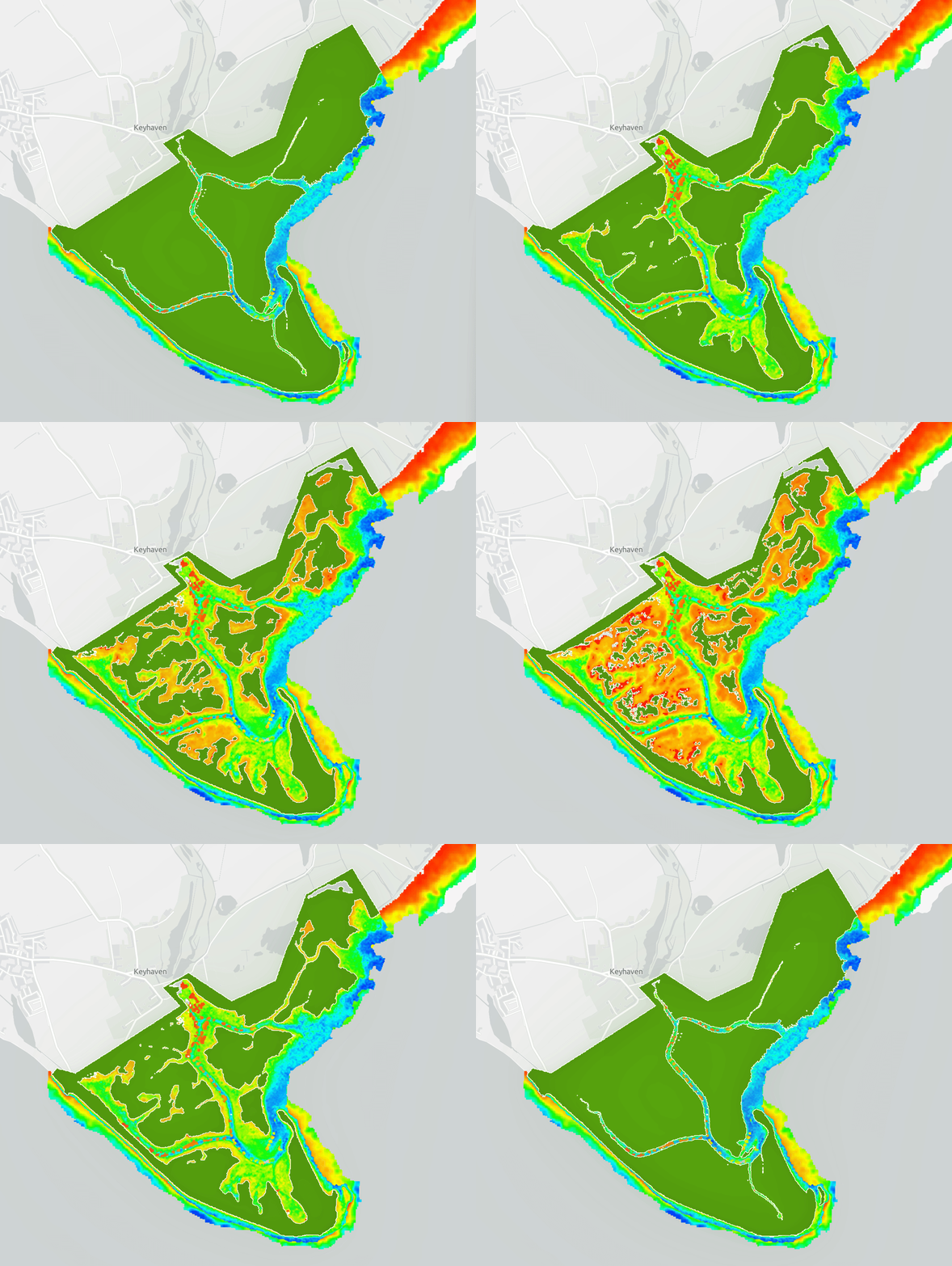
Planet Labs imagery demonstrates the significant tide-range present around Hurst Spit, UK​

Leveraging multispectral imagery from PlanetLabs and Synthetic Aperture Radar (SAR) data from Capella Space, TCarta derived high-resolution coastline vectors and intertidal zone boundaries tied to real-time water levels. These vectors, available as both a time series and real-time snapshots updated every five minutes, were benchmarked against tide gauges and tide models, offering high temporal accuracy.

Gif demonstrates Satellite Derived Coastline changes(green) in 5 minute increments, overlaid with Satellite Derived Bathymetry

To ground truth and validate the results, TCarta compared their satellite-derived coastlines with traditional datasets from the UK Hydrographic Office and Ordnance Survey. This revealed critical variations based on data source, resolution, and tide level, underscoring the challenges of managing a constantly shifting land-sea interface.

The demonstrator also featured satellite-derived bathymetry (SDB) using Sentinel-2 and PlanetScope imagery, showcasing how space-based remote sensing methods produce reliable depth data in areas inaccessible to traditional survey methods. These datasets, delivered via OGC-compliant APIs and visualized through a custom web application, enable integrated coastal monitoring and data sharing across platforms.

There are multiple, disparate coastline and intertidal features from different sources

Lessons learned emphasized the influence of vegetation, seasonality, and spatial resolution on remote sensing outputs, while recommendations pointed toward the use of dynamic, water-level-attributed coastline products and the integration of AI/ML for improved feature classification.

TCarta’s demonstrator is a powerful proof of concept for how space-based technologies can bridge the gap between terrestrial and marine data, offering scalable, near-real-time solutions for coastal resilience, planning, and environmental stewardship.

Click here to view and interact with the OGC demonstrator!

Back to Blogs

Enhance Bathy Lidar Collection Planning with Space-Based Water Quality Monitoring

Amy Anfinrud · April 15, 2025 ·

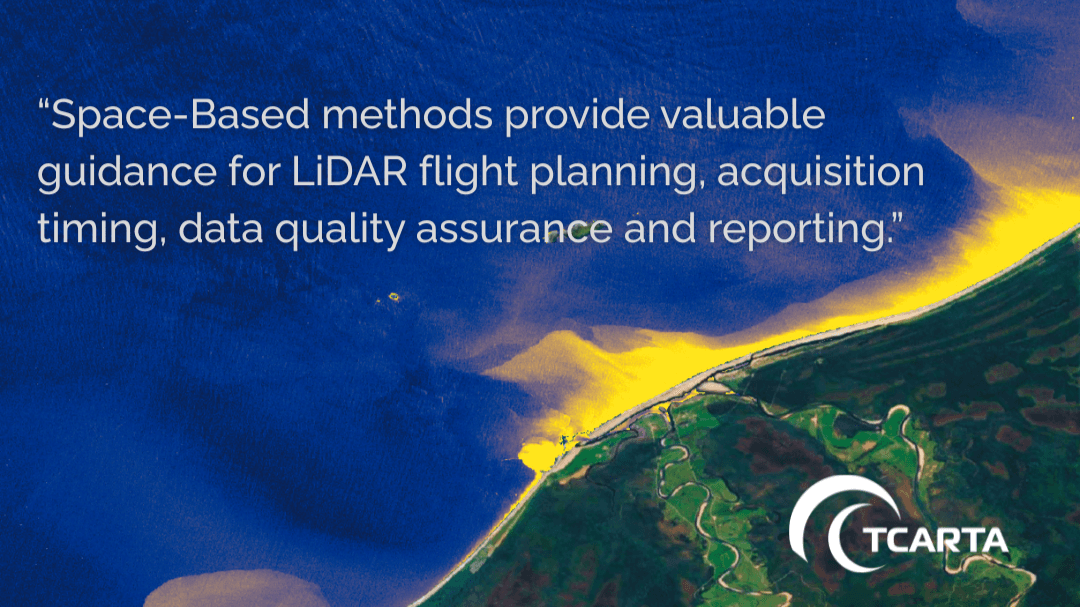
Accurate and timely environmental data is critical for the success of hydrographic surveys. One increasingly valuable tool in this domain is space-based water quality monitoring, which offers powerful support for airborne LiDAR bathymetry programs. By assessing daily and historical water clarity conditions from satellite imagery, this method provides essential guidance for flight planning, acquisition timing, data quality assurance and reporting.

Why Water Quality Matters for LiDAR

The performance of bathymetric LiDAR systems is highly dependent on water clarity. Turbid or sediment-rich waters scatter and absorb the laser pulses used in LiDAR surveys, reducing their ability to penetrate the water column and reach the seafloor. This makes understanding water quality—especially parameters like turbidity, suspended particulate concentration, and light attenuation—vital for ensuring successful, cost-efficient LiDAR acquisitions.

Existing methods rely on in situ measurements, which are costly and require mobilizing personnel and equipment. As a result, data collection is often limited to a few points. Alternatively, some approaches depend on local knowledge or visual assessments from the air. While these approaches can help determine broad acquisition windows, they often lack spatial and temporal precision which is vital for detailed planning and contextualizing data quality. 

Processed multispectral satellite image from February 2023 showing Turbidity (FNU)

Space-Based Monitoring: A Strategic Advantage

Using high and moderate resolution multispectral satellite imagery from platforms such as Sentinel-2 and PlanetScope, TCarta offers a robust and cost-effective satellite water quality monitoring service. This service enables both historical and near daily evaluation of water conditions across survey sites.

For planning bathymetric lidar flights, satellite-derived data can:

  • Identify optimal collection windows when water clarity is most favorable.
  • Detect turbidity plumes that may limit LiDAR acquisition.
  • Support adaptive flight planning, adjusting flight plans or survey sites to maximize  success based on physics-based analysis.
  • Contextualize data quality after acquisition.

Core Water Quality Metrics

Key parameters analyzed through satellite-based methods include:

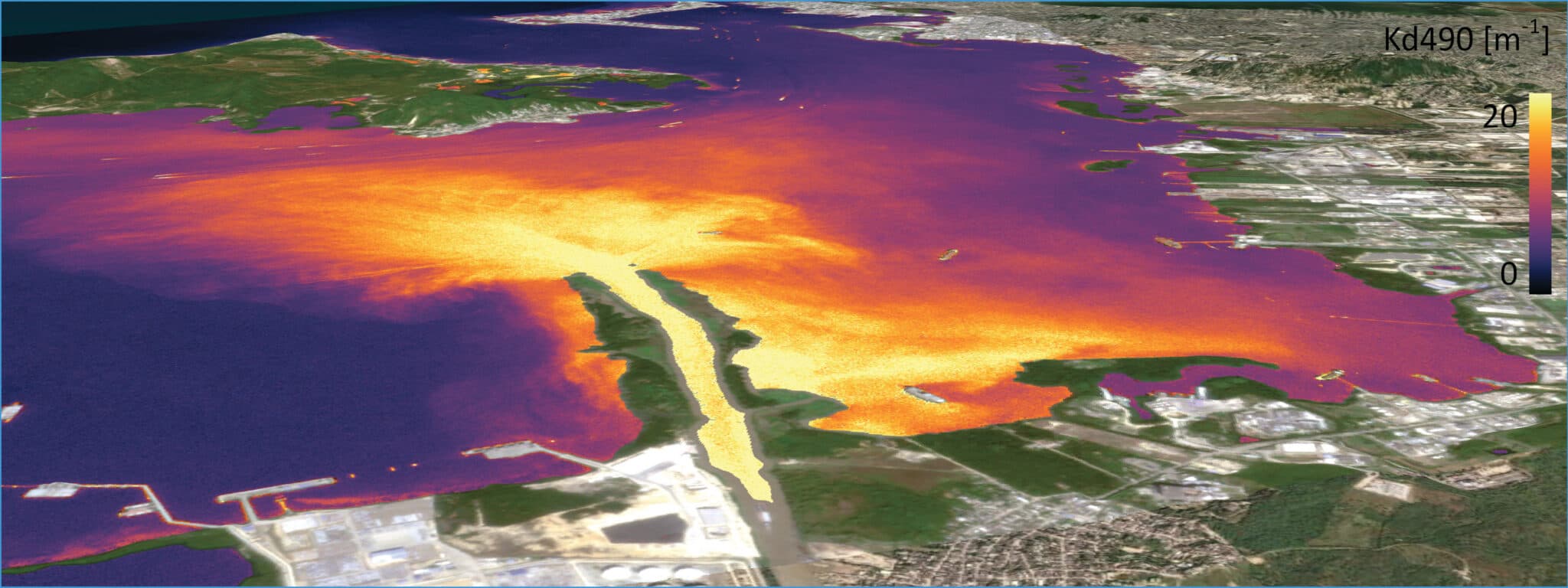
  • Kd490: The diffuse attenuation coefficient at 490nm (blue/green). Quantifies the rate at which blue/green light is absorbed and scattered as it travels through the water column.
  • bb490: The backscattering coefficient at 490nm. Indicates the amount of blue/green light scattered back towards the sensor by particles and other constituents in the water column.
  • bbp533: Particulate backscattering coefficient at 533nm. Indicates the amount of green light scattered back toward the sensor by particles. A good proxy for LiDAR laser penetration.
  • Secchi Depth: An indication of how deep light can penetrate into the water column using a simulated Secchi disk.
  • SPM: An estimate of the amount of suspended particulate matter in the water column.
  • Turbidity: The amount of scattered light proportional to the concentration of particles in the water. Sensitive to particle size, shape, composition, density, and color.
Example of customized Water Quality Dashboard

By combining daily PlanetScope observations with historical Sentinel-2 data, daily monitoring data can be evaluated against historical trends for more accurate anomaly detection. This customizable multi-temporal approach helps surveyors understand both seasonal patterns and real-time shifts in water clarity, supporting strategic mission execution.

Broader Applications: From Planning to Environmental Monitoring

In addition to supporting LiDAR surveys, TCarta’s water quality monitoring is also used across multiple sectors. One key application is the detection and tracking of harmful algal blooms (HABs), which pose risks to ecosystems, public health, and fisheries. Industries such as aquaculture, coastal engineering, and marine construction also benefit from reliable, up-to-date water quality information.

Deliverables

Clients receive access to a customized and dynamic web dashboard along with downloadable reports, graphs, and time series charts. These tools allow users to:

  • Monitor trends over time.
  • Compare current water conditions with historical baselines.
  • Make informed decisions during and after survey operations.
  • Report on water conditions as they relate to collection success.
  • Identify if reflights to infill data gaps will be successful.

Case Study: Florida Coastal Mapping:

Mapping Florida Waters

A Smarter Approach to Survey Success

Space-based water quality monitoring transforms how bathymetric LiDAR missions are planned and executed. By giving surveyors “eyes in the sky,” it enhances operational efficiency, data quality, and overall mission outcomes.

As a leader in satellite-derived marine data solutions, TCarta offers satellite-based Water Quality Monitoring as a key service for LiDAR survey planning and operational support. This forward-looking approach continues to revolutionize the way we collect, analyze, and act on hydrospatial information.


Please contact us through the form below to scope your project or discuss capabilities

Click or drag a file to this area to upload.

What is one plus four (write the number)?

Loading

Beyond Either/Or: Integrating Hydrographic Technologies for a Data-Driven Future

Amy Anfinrud · March 31, 2025 · 2 Comments

For too long, discussions about hydrographic surveying methods have centered on comparing and contrasting individual technologies – multibeam vs. lidar, lidar vs. satellite, satellite vs multibeam. This “either/or” and one vs the other mentality is outdated. Each of these methods, whether using sound, light, or reflectance, is an imperfect tool for measuring a complex environment. Instead of debating the merits of one approach over another, we need to embrace a “both/and” strategy. The future of hydrography lies in intelligent integration, seamlessly combining diverse technologies for maximum efficiency, cost-effectiveness, and environmental responsibility. This article argues for a paradigm shift: moving from sequential, siloed approaches to a holistic, vertically integrated model that leverages the unique strengths of each technology.

Read on Hydro International

The Inefficiency of the Status Quo:

Current practices often fall short. We see examples of operational inefficiencies: lidar flights over remote islands without prior weather or water condition checks via readily available or tasked satellite imagery; repeated topobathy lidar reflights for small areas easily filled by satellite data; small vessel surveys in coastal zones running aground on unsurveyed shoals – all preventable with integrated approaches. Even in regions with open data policies, the time lag between data collection and availability can be significant, especially given the rate of environmental change. These operational gaps are not just inconvenient; they often represent wasted taxpayer dollars and missed opportunities for enhanced safety. A cost-focused argument demands that we maximize the value of every survey, prioritizing operational efficiency and focusing on desired outcomes, not simply sensor-based specifications.

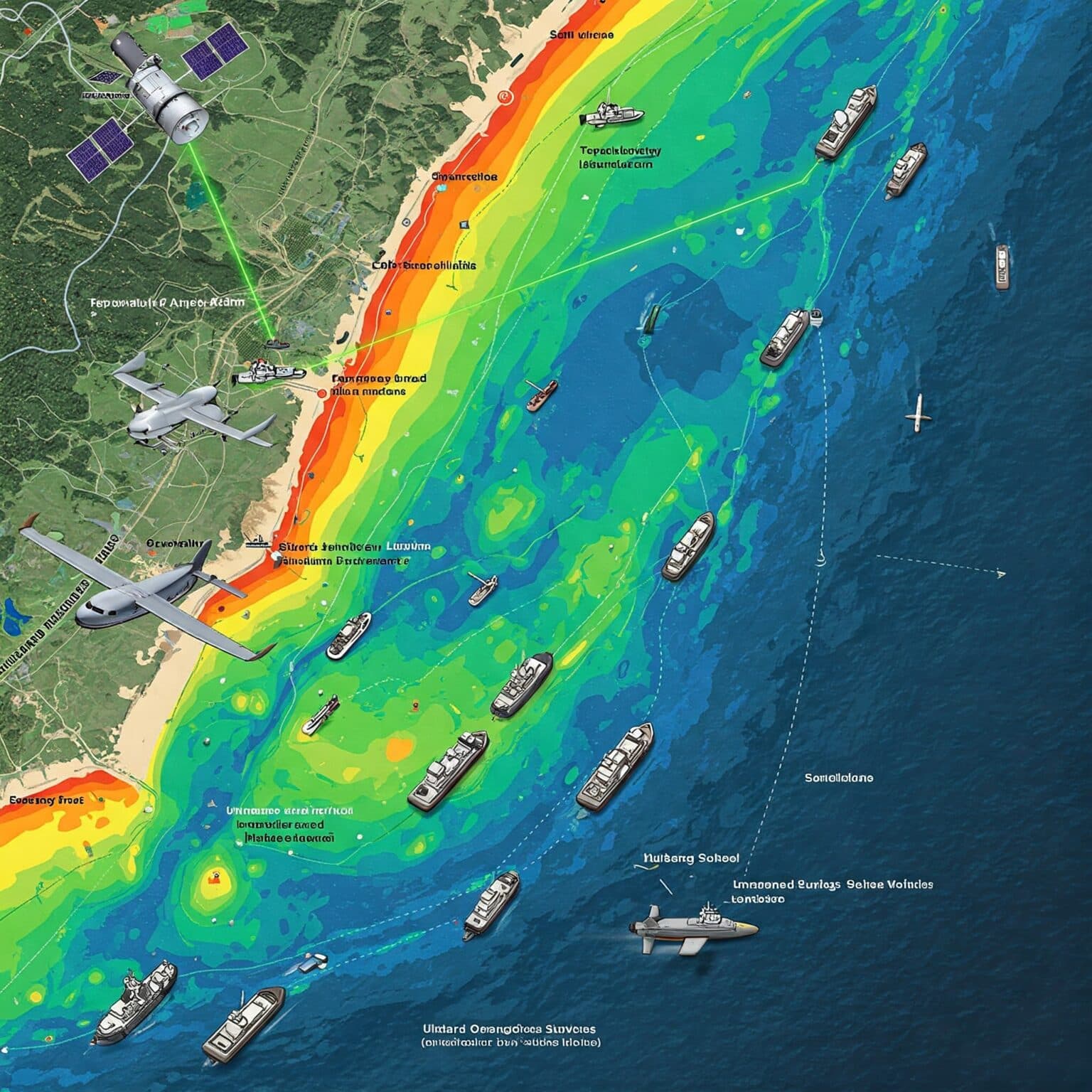
An artificial intelligence perspective on integrated systems for coastal mapping based on prompts from this article on Hydro International content on hydrographic mapping technologies. (AI-generated image by Gemini)

A Vision for Integration:

Imagine a hydrographic workflow where satellite-derived bathymetry (SDB) informs and improves topobathymetric lidar acquisition, identifying optimal flight times based on daily water clarity trends, minimizing reflights. SDB then serves as a planning tool for multibeam surveys, optimizing track lines and enhancing safety by highlighting potential hazards. This integrated approach is not just theoretical. We see promising examples like Land Information New Zealand’s (LINZ) forward-thinking approach in New Zealand, mandating water condition tracking to optimize bathymetric lidar collection. 

The hydrographic landscape is transforming, and integrated hydrography is no longer just a vision; it’s a necessity.

Kyle Goodrich; TCarta President & Founder

SDB and other Earth Observation (EO) data also have use as the geospatial “glue” connecting land and sea, bridging the intertidal zone and providing a valuable baseline for higher-resolution data. A recent example of this approach can be seen on NOAA’s Office for Coastal Management (OCM) with an example of high resolution topobathymetric models with SDB included at the coastline, bridging the gap between hydrographic data and topography in a challenging location for coastal mapping: Alaska.  

This integration extends into unmanned vessel data acquisition. SDB can de-risk USV operations through mission planning and hazard avoidance. The technology exists today for satellite-derived electronic charts to provide reconnaissance for a USV operating in remote islands in the Pacific Ocean with digital chart information delivered via space-based high speed internet.

Reversing the situation, information from lidar collection and in situ measurements from field operations can inform and improve SDB models, creating a powerful feedback loop for continuous improvement. USVs can provide valuable in situ for validation of SDB surfaces where other means are not available. This is technology integration: a full stack of sensors, from satellites in space to underwater vehicles and seafloor devices, focused on a challenging problem: mapping and characterizing the ocean floor and coastal zone.

Overcoming Barriers and Embracing the Future:

Several barriers or disincentives hinder widespread integration. Government RFQs and framework contracts often contract out individual survey technologies separately, discouraging integrated solutions. The biggest obstacle may be mindset. We must move beyond the “either/or” thinking and recognize the synergistic potential of integrated approaches. This requires a shift in RFPs and framework processes, requiring integrated solutions and focusing on the best approach for the specific location, not just a pre-determined platform or survey method.

The rise of the blue economy, with its increasing emphasis on environmental monitoring, further strengthens the case for EO in coastal mapping. With advancements like wave kinematic bathymetry, space-based lidar’s well-proven capabilities, and the development of high-resolution customizable hyperspectral satellites, the future of satellite-based hydrography itself is multi-modal and one of integrated techniques.  Perhaps that is what draws ‘future hydrographers’ and next generation ocean explorers to the alternative hydrographic method of satellite based surveying.

Parting Thoughts:

The hydrographic landscape is transforming, and integrated hydrography is no longer just a vision; it’s a necessity. By combining the strengths of diverse technologies – from SDB and lidar to multibeam and USVs – we can unlock unprecedented levels of efficiency, cost-effectiveness, and environmental stewardship. This integrated approach isn’t just about better data; it’s about a deeper understanding of our oceans and a commitment to a sustainable future. Recent industry developments, such as the acquisition of a leading satellite-derived bathymetry and Earth observation company by the world’s largest hydrographic survey firm, signal a clear trend: the future of hydrography is vertically integrated. Earth observation is no longer a niche technology but a core component of modern hydrographic solutions. This acquisition validates the growing importance of SDB and EO and underscores the value of integrated services for an “all-sensor” approach. To further accelerate this evolution, my company encourages collaboration and partnerships in this arena. It’s time to move beyond “either/or” and embrace the power of “all of the above and below,” working together to shape the future of hydrography.

Connecting Remote Communities: Providing Up-to-Date Data with Satellite-Delivered Bathymetry

Amy Anfinrud · March 3, 2025 ·

By: David Bautista

Coastal zones have always been an attractive extent for human settlements, providing plenty of natural resources and economic advantages. This interface between land and sea provides multiple benefits, including commerce, trade and transportation, marine resources, and tourism. 

Unfortunately, settlements in far-away and isolated regions face diverse environmental and social challenges. Limited access to health, supplies, and education services; demographic changes affecting the available labor force such as out-migration; higher costs of living; high reliance on natural resources for sustenance; and extreme weather conditions are some examples. 

The effects of global warming also have a major impact on those communities, particularly in the Arctic and Subarctic regions. Remote coastal communities are more vulnerable to environmental and socio-economic impacts of climate change, including coastal flooding, shoreline erosion, saltwater intrusion, habitat loss, and threats to economic activities (fishing, harvesting, and tourism).

There is a greater need for accurate and up-to-date information, especially to understand the morpho-hydrodynamic behavior of coastal areas (seasonal changes in erosion, and transport of sediment and deposition). Monitoring these very dynamic natural systems is thus of great importance for supporting remote communities as well as the conservation of natural resources.

For this reason, governments step in to support adaptability and resilience, and adequate levels of connectivity. Bathymetry with high spatiotemporal resolution is the primary and essential input for understanding the dynamics of coastal systems. However, traditional survey methods, such as multibeam echosounder (MBES) ship-borne, Light Detection and Ranging (LiDAR) airborne, and ground-based are not the most suitable techniques for addressing these concerns.

Traditional survey methods (MBES and LiDAR) provide very high resolution with fine vertical accuracy. However, these techniques face economic and logistic constraints, as well as challenges to map large areas relatively quickly. Thus, Spaceborne Remote Sensing techniques represent an efficient and cost-effective method for mapping remote and hazardous environments. 

Satellite Derived Bathymetry (SDB) can return seafloor depths using spaceborne sensors, such as Sentinel-2, LandSat, Pléiades, WorldView, GeoEye, Planet, and Capella SAR. SDB provides low-cost and un-intrusive solutions with the ability to map changes over time in large remote areas. As a result, SDB is considered to be an overly appropriate alternative to provide data acquisition in remote communities. SDB can be a cost-effective and efficient way to fill in data gaps, support safe navigation (updating nautical charts data in the coastal waters), and enhance the understanding of the marine environment.

10m SDB over Inukjuak, QC, Canada

Through a Canadian Hydrographic Service (CHS) contract and with IIC Technologies as Prime Contractor, TCarta facilitated 10m SDB datasets in the waters around Inukjuak and Ulukhaktok, Canada.

Inukjuak is a remote, traditional Inuit community located in Nunavik, Northern Quebec, Canada, with more than 1,500 people bordering the Hudson Bay. The region is influenced by the Southern Arctic conditions and characterized by a cold dry climate with a continuous permafrost. The mean annual temperature is -6ºC; cold conditions persist over long periods during winter (mid-November to March), where temperatures less than -15ºC persist and thaws are infrequent. Hudson Bay usually freezes by the end of December, near the coastline, and ice usually melts in late June or early July.

Ulukhaktok, another Inuit community with fewer than 500 inhabitants, is located on the west coast of Victoria Island, the second largest island in the Canadian Arctic archipelago and the ninth-largest island on Earth. There are prominent cliffs that line the shore, lowlands, and numerous ponds, lakes, and rivers. Seasons are weather and ice dependent. Summer is characterized by open water from early July to September; during fall (October through mid-November) sea ice freeze-up, and winter is characterized by frozen sea conditions. Speed and direction of the wind influence sea ice freeze-up and breakup.

Both communities are only reachable by plane, helicopter or boat. Its economy depends on hunting,  fishing, trapping, and gathering; hunters and fishers catch wildlife and fish from the waters and islands of Hudson Bay in Inukjuak and the coastal waters of Prince Albert Sound and Minto Inlet in Ulukhaktok.

Understanding the importance and relevance of surveying all optically shallow water in these regions; TCarta deployed a hydrospatial survey with cutting-edge remote sensing techniques. The negative effects of local water column and atmospheric conditions were controlled using multi-temporal image composites. Sentinel-2 Level-1C imagery was selected, and a minimum of 100 singular atmospherically corrected images were statistically combined. The combination of multi-temporal images allowed to obtain the “best” pixels for SDB derivation.

TCarta successfully delivered 982.8 km² of SDB coverage, 855.2 km² in Inukjuak and 127.6 km² in Ulukhaktok. The efforts for this hydrospatial survey will benefit both communities with up-to-date data. Lastly, TCarta is pleased to announce how the produced SDB accomplished the overlaying goals of filling the gaps in coastal bathymetry, enhancing understanding of the marine environment (especially, the fact that its economy certainly depends on hunting and fishing, and filling data gaps supports such activities), and supporting safe navigation in the Canadian Arctic. This type of project exemplifies the necessity of state-of-the-art SDB technology in remote locations, and the capabilities of hydrospatial solutions.

TCarta Announces Satellite Derived Bathymetry Product to Supplement Official Nautical Charts in Shallow Coastal Zones

Amy Anfinrud · February 26, 2025 ·

Shallow coastal zones are where most ship groundings occur, and they are also where the most inaccurate and outdated information on official nautical charts resides. TCarta, a provider of hydrospatial mapping services, has introduced a new line of Satellite Reconnaissance Charts to supplement official marine navigation maps in shallow waters.

Read in LiDAR Magazine

3D view of Negril, Jamaica, showing 1:4,000 scale TCarta Satellite Reconnaissance Chart with 3m resolution Satellite Derived Bathymetry.

TCarta will introduce the new Satellite Reconnaissance Chart products to the hydrographic community on Tuesday, February 25, at the 2025 Esri Federal GIS Conference in Washington, D.C.

Derived from recently acquired satellite imagery, TCarta Satellite Reconnaissance Charts are digital maps adhering to International Hydrographic Organization S-57 and S-100 data model standards with the same appearance and symbology as official navigation aids. However, the TCarta Charts do not replace official nautical map products, which are primarily designed for marine navigation in commercial shipping lanes.

The new TCarta Satellite Reconnaissance Charts contain up-to-date details of seafloor depths, sandbars, reefs, shoals, and other submerged hazards – along with floating dangers – in the near-shore environments that are often poorly mapped or out of date on official maritime charts. Offered at off-the-shelf 1:20,000 scale and custom 1:4,000 scale, the TCarta products are delivered in file formats ready to load into popular marine navigation software as well as common GIS software platforms.

“We launched the Satellite Reconnaissance Charts to enhance the awareness and safety of vessels operating in shallow waters, such as recreational boats, private yachts, fishing vessels, and military ships,” said TCarta President Kyle Goodrich.

Another major user of these products, however, will be government hydrographic offices, explained Goodrich. The TCarta Charts will serve as accurate and timely guides for those organizations to plan hydrographic surveys to update official nautical charts, especially in dynamic coastal zones, enabling their operations to be more efficient and avoid hazardous situations.

“Collection of high-quality water depth measurements in shallow coastal areas is expensive and dangerous to acquire by ship or aircraft, notably in remote or contested regions,” Goodrich said. “Our Satellite Reconnaissance Charts will help reduce risk, time and costs in coastal hydrographic surveying.”

The Satellite Derived Bathymetry (SDB) technology refined by TCarta and used to create the new Reconnaissance Charts is uniquely suited to measure water depth accurately and inexpensively while posing no danger to personnel, equipment, or coastal ecosystems. SDB applies physics-based computer algorithms to optical imagery captured by commercial remote sensing satellites. This analysis detects and measures light reflecting off the seafloor to calculate water depth. Depending on water clarity, SDB is accurate to depths of 20 to 30 meters.

TCarta has mapped nearly one third of the world’s coastlines with SDB and offers products in custom and off-the-shelf versions. Custom SDB data sets are typically generated using high-resolution satellite imagery capable of resolving seafloor objects, such as shoals and reefs, with one-meter resolution. Satellite Reconnaissance Charts can be created for nearly any shallow-water area in the world and are available off the shelf now in the following regions:

  • Caribbean
  • Arabian/Persian Gulf
  • Red Sea
  • Many Pacific Islands
  • Florida and Mexican Coasts

Satellite Reconnaissance Charts are available for specific locations, regions, and entire countries.  Commercial organizations may order bathymetry products directly from TCarta and the US government can purchase through the GSA Schedule.

Satellite-Based Solution to Ship Groundings in Coastal Waters

Amy Anfinrud · October 3, 2024 ·

Multiple recent incidents in which naval and commercial vessels ran aground have highlighted the dangers of maritime operations in shallow or poorly charted coastal waters. TCarta Marine of Denver offers a cost-effective, environmentally safe solution using Earth observation satellites to derive accurate water depth measurements in near-shore areas.

Read in Environment Coastal & Offshore Magazine

TCarta Satellite Derived Bathymetry (SDB) on the Oman Coast indicates shallow water depths by color – red represents 0-3 meters, yellow is 3-6 meters, green is 6-10 meters, turquoise is 10-14 meters, and blue is 14-18 meters deep. Inset map indicates geographic location of data set.

“While the exact causes of recent ship groundings off the coasts of Oman, Greenland, and Fiji are under investigation and often complex, the risk of such accidents can be significantly reduced with up-to-date bathymetric data produced from satellite imagery,” said TCarta President Kyle Goodrich. “Often in coastal areas, the regions outside commercial shipping lanes are poorly charted or not surveyed.”

Unfortunately, the collection of high-quality water depth measurements in shallow coastal areas – where they are needed the most – has traditionally been expensive and dangerous to acquire with ships or aircraft, especially in remote or contested regions, Goodrich said. And the risk of groundings is only growing as military vessels and eco-tourism charters increasingly operate in unfamiliar and inadequately mapped coastal zones.

For over 10 years, TCarta has been supplying marine charting organizations with water depth data using a technique called Satellite Derived Bathymetry (SDB). SDB applies physics-based computer algorithms to optical imagery captured by commercial remote sensing satellites. This analysis detects and measures light reflecting off the seafloor to calculate water depth. Depending on water clarity, SDB is routinely accurate to depths of 20 to 30 meters.

“In addition to posing no danger to personnel, equipment, or coastal environments, satellites are more cost effective than ship-borne sonar or airborne laser scanning because they acquire image data over large regions in seconds,” said Goodrich. “And because satellites orbit without geographic restrictions, data can be collected for areas otherwise off limits to vessels or aircraft.”

TCarta has mapped nearly one third of the world’s coastlines with SDB and offers products in custom and off-the-shelf versions. Custom SDB data sets are typically generated using high-resolution satellite imagery capable of resolving seafloor objects, such as shoals and reefs, with one-meter resolution.

The off-the-shelf bathymetry product Global Satellite Derived Bathymetry (G-SDB) offers 10-meter detail and is ideal for identifying coastal shoals in remote areas that don’t appear on nautical charts. Large-area contiguous G-SDB products are immediately available for more than a dozen critical locations, including:

  • South China Sea
  • Arabian/Persian Gulf
  • Gulf of Oman
  • Red Sea
  • Black Sea
  • Eastern Mediterranean

Government and commercial organizations may order bathymetry products directly from TCarta or through the GSA Schedule.

Interns map 39,000km² of seafloor for Seabed 2030

Amy Anfinrud · August 27, 2024 ·

Six students took part in a summer-long paid satellite-derived bathymetry (SDB) internship facilitated by TCarta and hosted at the Marine Institute (MI) of Memorial University in St. John’s, Newfoundland. All participants were either recent graduates or current students in the MI Ocean Mapping programme. The programme’s mobilization was a collaborative effort among TCarta, Memorial University and The Nippon Foundation-GEBCO Seabed 2030 Project, which aims to inspire the complete mapping of the seafloor by 2030.

Read in Hydro International

As the second annual internship concludes this week, the student interns have successfully produced 39,304km² of 10m-resolution SDB across four areas of interest worldwide, all within just eight weeks. The SDB was generated for the coastlines of Somalia, the Mosquito Coast, the Galapagos and the islands of the Lesser Antilles. This bathymetry will be contributed to the Seabed 2030 initiative, just as last year’s internship results from Madagascar, Newfoundland and the Canadian Arctic were.

Pre-processing tool

During the summer, students were equipped with essential hydrographic skills. They were introduced to a range of satellite imagery options for SDB and learned to evaluate the strengths of each for various project applications. TCarta provided training on using a pre-processing tool to prepare in situ data from sonar or Lidar, which served as calibration datasets for processing satellite images. Additionally, the students were taught how to apply an enhanced version of a traditional band ratio algorithm alongside a machine learning algorithm in iterative processes to derive water depth measurements from individual image pixels.

These hydrospatial skills have proven invaluable, not only by contributing to the Seabed 2030 initiative but also by preparing and inspiring future hydrographers. The technical expertise and knowledge they have acquired will continue to benefit the field of hydrography.

Six Marine Institute summer interns, along with two TCarta employees and one Marine Institute staff member, mapped nearly 40,000km² of seafloor.
back to newsroom

TCarta, Seabed 2030, and Marine Institute Summer Interns Produce 40,000 km² of SDB

Amy Anfinrud · August 15, 2024 ·

The future of hydrospatial is looking bright

Six students participated in the summer-long paid SDB internship facilitated by TCarta and held at the Marine Institute (MI) of Memorial University in St. John’s, Newfoundland. All six students are recent graduates or currently enrolled in the MI Ocean Mapping program. Mobilization of the program was shared among TCarta, Memorial University and The Nippon Foundation-GEBCO Seabed 2030 Project, which seeks to inspire the complete mapping of the seafloor by 2030.

6 Marine Institute summer interns, 2 TCarta employees, and 1 Marine Institute staff member

With the 2nd annual Internship wrapping up this week, the student interns successfully produced 39,304 km2 of 10m resolution Satellite Derived Bathymetry (SDB) in 4 areas of interest around the world in a mere 8 weeks! SDB was produced on the Coastline of Somalia, Mosquito Coast, the Galapagos, and  islands of the Lesser Antilles. This Bathymetry will be contributed to the Seabed 2030 initiative, as were last year’s internship results in Madagascar, Newfoundland and the Canadian Arctic.

Students were taught many key capabilities during the summer. For instance, they were introduced to the variety of satellite imagery available for SDB and studied the strengths of each for certain project types. TCarta also instructed the interns on how to use a pre-processing tool to prepare in situ data from sonar or Lidar as calibration datasets for processing the satellite images.

Furthermore, they learned how to apply an enhanced version of a traditional band ratio algorithm along with a machine learning algorithm in iterative processes to derive water depth measurements from individual image pixels.

These hydrospatial skills have proved valuable- not only contributing to the missions of the Seabed 2030 initiative- but also to help prepare and inspire students to be the hydrographers of the future. We are proud of the valuable technical skills and knowledge they have brought and will continue to bring to the world of Hydrography.

Back to Blogs

Navy receives support and training in sargassum detection

Amy Anfinrud · August 5, 2024 ·

Five members of the Dominican Republic Navy received training and instruction to work on detecting sargassum

Read in elCaribe

Members of the Dominican Navy received training to work on sargassum detection and Satellite Derived Bathymetry (SDB). In addition, participants received additional training on how to identify sargassum using satellite imagery. However, sargassum is known to come to our beaches and coastal areas, creating a nuisance for both tourists and locals. Likewise, this multi-day training was made possible thanks to the collaboration between the Nippon Foundation-GEBCOSeabed2030 project and TCartaMarine with the Dominican Navy.

This training comes at a very important time considering that the country’s Hydrographic Service has been inactive for around 30 years. Since 2015, great efforts have been made to learn new technologies and experts within the Navy and contribute to the country.

Nippon Foundation and its help in the detection of sargassum

A collaboration between the Nippon Foundation and the General Bathymetric Chart of the Ocean (GEBCO), which operates under the joint auspices of the International Hydrographic Organization and the Intergovernmental Oceanographic Commission (IOC) of UNESCO, Seabed 2030 is a global accelerator of ocean mapping. Seabed 2030 inspires the complete mapping of the global ocean by 2030.

The Dominican Republic has been a member of the IHO since 1967. Just last year at the National Palace, President Abinader received the Director of the IHO, Luigi Sinapi. There, the sustainable use of the oceans and the importance of hydrography in the Dominican Republic were discussed. SDB is an ideal method for collecting bathymetry measurements in shallow waters. TCarta founder Kyle Goodrich on the importance of training for communities and institutions around the world.

Advances in hydrography in the Dominican Republic

Thanks to the Commander General of the Navy, Vice Admiral Agustín Morillo Rodríguez , members of the Navy received training in how to process and compile SDB data. Including Frigate Captain Primitivo López, Director of the Hydrographic Service

Sheila Caceres, a member of the Seabed 2030 Atlantic and Indian Ocean Regional Centre. She helped establish this collaboration and training opportunity, and is attending the training event.

In addition, this training is a set of national coastal bathymetry data with ten-meter resolution generated by the Hydrographic Service. This for use in environmental models, conservation efforts and other specialized uses within the Service. In addition, this training leaves a group of technical experts in SDB for the Navy. With the capacity to continue developing, transmitting the knowledge and skills learned. The objective is to update nautical charts in order to have safe navigation for ships in jurisdictional waters.

Back to Newsroom

Exploring the Frontier of Environmental Monitoring: Utilizing Capella SAR for Blue Carbon

Amy Anfinrud · August 1, 2024 ·

The Blue Ecosystems and Their Importance

Read on Capella Space

In the quest to combat climate change, monitoring carbon storage across diverse ecosystems is critical. While forests are often in the spotlight for their role in carbon sequestration, lesser-known ecosystems like wetlands, mangrove forests, and seagrass beds are emerging as crucial players in the fight against climate change. These ecosystems sequester carbon dioxide from the atmosphere and store it in their biomass and sediments, making them highly effective carbon sinks offering a nature-based solution in carbon sequestration. Despite their importance, coastal ecosystems are increasingly threatened by human activities, including coastal development, pollution, and climate change. Fast, replicable, and verifiable methods of monitoring these dynamic ecosystems continue to be a significant challenge globally.

Red Polygon indicates current assessed extent by Global Mangrove Watch
Mangrove Health mapping & Classification with Capella SAR

Capella SAR Technology: Transforming Monitoring Capabilities:

Capella Space, a leader in harnessing the power of Synthetic Aperture Radar (SAR) technology to revolutionize Earth observation, is transforming the possibilities for monitoring  mangrove environments with unprecedented detail and frequency. With Capella’s constellation of small yet agile satellites equipped with SAR sensors, mangroves can be monitored night and day, at an unprecedented spatial resolution. Equipped with Capella SAR, TCarta is uniquely positioned to track changes in mangrove environments at sub-meter resolution.

Mangrove monitoring methods are scalable, global and have little to no limitations in assessing the health and extent of existing Mangrove based Carbon Credits
Marvivo Magdalena — Mangrove Species: Subset analysis of two different mangrove species in Baja California, Mexico.

With Capella SAR, TCarta can provide:

  – All-Weather Monitoring: SAR can penetrate clouds and operate day or night, providing continuous monitoring capabilities even in challenging weather conditions prevalent in tropical regions where mangroves thrive.

  – High Spatial Resolution: Capella’s SAR satellites capture images with resolutions down to 50 centimeters, enabling detailed mapping of mangrove structure and extent. With the majority of global assessments and datasets regarding mangrove extent at or larger than 10 meters, TCarta offers a solution that is 20x the spatial resolution. This high resolution is crucial for accurately delineating new growth, changes in canopy dynamics, and monitoring changes in mangrove cover over time.

  – Frequent Revisit Times: With multiple satellites in orbit, Capella provides frequent revisits to specific areas, allowing for near real-time monitoring of mangrove dynamics. This capability is essential for assessing seasonal changes, supplementing measurement, reporting, and verification (MRV) of blue carbon assets, and allowing clients a deeper understanding of current and potential blue carbon assets.

Delta Blue Carbon Analysis — Mangrove Health and Extent: Subset analysis of current health and extent in Karachi, Pakistan
Allcot AG — Mangrove Health: Subset analysis of current health and extent in Sinaloa, Mexico

TCarta Innovation:

TCarta, in partnership with Capella Space, has developed a precise mangrove detection and monitoring technique using high-resolution SAR data. TCarta leverages SAR characteristics such as surface roughness, texture, and backscatter values, along with advanced processing and machine learning, to accurately map mangrove extent, monitor changes in their health and extent over time, and estimate carbon stocks in mangrove biomass and sediments. This approach supports habitat assessment, restoration efforts, and climate change mitigation strategies, allowing companies to perform their own due diligence when investing in mangrove-based carbon reduction assets.

Back to Newsroom

Global Satellite-Derived Bathymetry

Amy Anfinrud · June 12, 2024 ·

New Satellite Sensors Continue to Improve Technique

—Read in Sea Technology—

In less than a decade, satellite-derived bathymetry (SDB) has evolved from a shallow-water mapping technology that could be applied only in clear, calm waters to one that can now be used cost-effectively and reliably in a wide variety of coastal environments around the globe. A 2023 project conducted in the challenging waters of Alaska was one of several that highlighted the arrival of SDB as a commercially viable, globally applicable seafloor mapping technique.

TCarta Marine of Denver, Colorado, successfully completed the Alaska project despite the presence of nearly every environmental condition that traditionally thwarted SDB production. The results were impressive: Seafloor depths were measured down to 26 m in Kachemak Bay and to 3 m in the murky and turbulent Arctic waters of Point Hope. Additionally, the data sets were delivered on time and within budget to the customer, NOAA’s Office of Coastal Management, and the data were made freely available to the public via the NOAA Digital Coast website: https://coast.noaa.gov/dataviewer/#/.

Fully appreciating the significance of this effort requires an understanding of SDB technology. It involves the analytical processing of the red, green, blue and infrared bands in optical multispectral satellite imagery. These spectral signatures captured by space-based sensors result from light energy penetrating the water column and reflecting off the seafloor. Processing these spectral reflectance values with specialized SDB algorithms calculates the depth of the water.

SAR-based intertidal zone mapping achieved with Capella Space satellites synchronized to capture imagery at high- and low-tide periods. Pink area indicates the intertidal zone in Yakutat, Alaska.

Numerous factors, however, can foil the SDB methodology. Darkness and cloud cover entirely prevent image collection by optical satellites, while the presence of sea ice and high levels of sediment or chlorophyll in coastal waters hinders light penetration, thereby eliminating seafloor reflectance and SDB derivation. The polar regions experience excessive cloudiness and six months or more without adequate sunlight for SDB. During summer months, glacial runoff creates highly turbid waters in addition to large-scale phytoplankton growth due to 24 hr. per day of light. Overall, the conditions for SDB in Alaskan waters are among the most challenging in the world. Despite these drawbacks, SDB is a popular mapping technique that has been applied reliably in many parts of the world and is a vital component to comprehensive coastal mapping programs. The primary benefit is that it can be used in shallow coastal zones that are too dangerous for shipborne methods, such as sonar, or too remote for deployment of airborne LiDAR.

Optical satellites, on the other hand, capture imagery globally across political boundaries and without risk to personnel, equipment, or the environment. The reduction in use of carbon-fuel-burning survey platforms is also a considerable benefit of satellite-based survey methods, and carbon costs are now becoming a consideration in international tenders for ocean mapping.

Geographic areas most amenable to SDB have traditionally included the Caribbean, Red Sea, Pacific atolls and the Arabian Gulf. Historically, SDB extraction from multispectral imagery was performed with one of two algorithms: Radiative Transfer or Band Ratio. The first is extremely computer intensive, sometimes taking days to process one image and requires extensive expertise. Band Ratio, on the other hand, is faster but requires calibration data, such as sonar or other direct depth measurement, which often aren’t available in remote or dynamic coastal zones, and high accuracy is limited due to areas of homogeneous seafloor.

The expansion of commercial SDB to parts of the world once thought impossible or impractical for it has resulted from a convergence of critical factors in just the past several years. These include dramatic improvements in satellite remote sensing capabilities, refinements in machine learning technologies to select images and derived water depths, and global availability of a secondary satellite-based bathymetric derivation method: space-based LiDAR.

The simultaneous emergence of these innovations has enhanced the quality and reliability of SDB measurements in places where it has always been applicable and expanded its technical viability to almost all environmental conditions and geographic locations. Just as importantly, the method can now be affordably applied in massive project areas, even if time and budgets are limited.

This is just the start of a paradigm shift in SDB methodology and applicability. There are additional advancements now being researched—mainly in the form of new satellite imaging technology—that will continue to enhance satellite-derived bathymetry.

Mapping the Alaskan Coastline

The success of the Alaska project would likely not have been possible if it weren’t for the research and development conducted under two Small Business Innovation Research (SBIR) grants awarded to TCarta by the National Science Foundation and NOAA between 2018 and 2022 with the goal of modernizing SDB techniques and expanding the pool of usable sensors. The research focused on overhauling the entire SDB workflow, devising tweaks to the algorithms themselves, as well as experimenting with new and better data imagery selection, data cleaning techniques and accuracy assessment.

The NOAA grant sought to specifically improve SDB outcomes in high-latitude areas such as Alaska and the Arctic. TCarta worked on the theory that notoriously turbulent coastal zones in this region experienced some calm days suitable for SDB. But pinpointing such ideal conditions that also coincided with periods of daylight dramatically narrowed the potential acquisition window of optical satellite image collection.

Fortunately, the availability of SDB-suitable imagery has exploded over the past 25 years with the launches of numerous optical imaging constellations. Gone are the days when the U.S. Landsat and French SPOT satellites were the only image sources, with imagery collected once a week at best. Today, there are numerous Earth observation systems in orbit operated by Maxar, Airbus, European Space Agency (ESA), Pixxel, Planet, Satellogic, and several others that provide a plethora of images to select from.

These satellites have been capturing imagery for years and amassing enormous archives of data covering the entire Earth. In many cases, these archives contain deep stacks of numerous images for each spot on the globe, some with hundreds of images to select from. In addition to more frequent acquisitions, some of these sensors capture reflectance data in different segments of the optical and infrared spectra, which enhance SDB by penetrating deeper into the water column, providing additional seafloor information and enabling more robust corrections for atmospheric distortions.

TCarta had been modifying the original SDB derivation algorithms with the addition of these new spectral bands and ratios of multiple bands and then applying machine learning to recognize the best results from the seafloor extraction process. It was a natural step to then apply machine learning to stacks of archived satellite images and find the ones with the clearest, calmest water conditions for SDB processing. From there, the process was refined to use machine learning to isolate and combine the best pixels from multiple overlapping images for derivation of water depths. Searching the archives manually to find images with the right characteristics would be impossible or too time consuming for practical application. Machine learning makes this possible.

For Alaska, TCarta processed high-resolution multispectral imagery from the Maxar and Planet archives to complete the project. These data sets were chosen for their high spatial resolution and frequency of imagery collection, which were required to meet the bathymetric accuracy requested by NOAA’s Office of Coastal Management. TCarta used a custom process to assimilate the radiometric measurements of the two different sensor systems for consistent SDB extraction.

Incorporation of machine learning into the SDB processing workflow has substantially reduced production time. TCarta routinely processes dozens to hundreds of images in the same time it would have taken for one just a few years ago. This has substantially improved the overall economics and viability of SDB as a commercial service.

Madagascar SDB produced and delivered to the Seabed 2030 global mapping initiative. Marine Institute of Memorial University of Newfoundland 2023 summer interns produced this country-wide data set using TCarta’s Trident Tools SDB software.

Adding Satellite LiDAR for Validation

The other major addition to the SDB workflow has been space-based LiDAR, or laser altimeter, data from NASA’s ICESat-2 satellite. Launched with the intent of measuring the thickness of sea ice, glaciers and tree canopies, the satellite also directly measures seafloor depth down to about 30 m under the right conditions. The LiDAR’s green laser emissions penetrate shallow water, reflect off the bottom, and return a signal to the sensor. The data can be processed to determine depth to high levels of accuracy.

The ICESat-2 measurements are made in single-point survey measurements with approximately 1 m between points along the track and with several kilometers between each track, which means the data cannot be used as a standalone bathymetric mapping tool for broad areas, but its value is still considerable.

ICESat-2 has proved to be the ideal validation and calibration data set that extends SDB utility to remote parts of the world where no control points can be collected or are otherwise unavailable from on-site methods. The ICESat-2 data are applied in two aspects of the modernized SDB workflow. The laser measurements are first employed as training data to train the machine learning algorithms to recognize water depths in optical imagery. The ICESat-2 points are also used to validate the accuracy of SDB calculations derived from the Radiative Transfer SDB method, enhancing the confidence in derived water depth values. By combining both methods and information from two satellites using independent methods for water depth derivation, greater confidence in the results is achieved.

Although TCarta uses the NASA data in all SDB projects now, the value of the data set was demonstrated most vividly in another 2023 project where TCarta performed bathymetric mapping of the entire Madagascar coastline. Mapping the coastal zone of the fourth largest island on Earth was noteworthy for several reasons, aside from its sheer size and remoteness. First, the project was supported by the Seabed 2030 program, which was also the recipient of the final products. Second, TCarta completed the SDB mapping in cooperation with students during a summer work term program at the Marine Institute (MI) of Memorial University in St. John’s, Newfoundland, Canada.

Due to a limited budget and grand ambitions to make large contributions to Seabed 2030, free imagery from the 10-m-resolution ESA Sentinel-2 satellite was used. Thousands of satellite images, many stacked over the same areas of interest, were obtained for the entire Madagascar coast. Without machine learning and ICESat-2, the SDB mapping project would have taken 12 months or more just a few years ago, but the student-involved teams completed it in a few weeks, achieving 24-m-deep measurements along the majority of the Madagascar coastline.

The technology and techniques developed under TCarta’s research grants have not only gone on to benefit the commercial and government projects, but also it has proven to be a tremendous instructional tool for future hydrographers and contributed significant data coverage to the global effort to map the entirety of the seafloor.

Seabed 2030 and Marine Institute of Memorial University of Newfoundland 2023 summer interns and facilitators. Plans for a 2024 (year two) intern program and data contribution to Seabed 2030 are underway.

The Future of SDB

The revolution in commercial imaging satellites has included two types of data collection systems that hold significant potential for SDB applications and supplemental coastal products. These are synthetic aperture radar (SAR) and hyperspectral satellite constellations. The primary advantage to SAR is that, unlike passive optical systems that capture reflected sunlight, radar sensors actively emit signals that can pass through darkness and clouds to bounce off the Earth’s surface and return data. This means they can collect data 24/7 anywhere on the globe. The key difference in recent SAR missions is their spatial resolution supports practical coastal mapping. Commercial SAR operators include Capella Space and Umbra in the U.S., ICEYE of Finland, and Synspective of Japan.

While SAR does not provide seafloor depth information due to lack of water column penetration, it does add important shoreline location data that can enhance SDB accuracy. TCarta has used the radar data collected at both day and night in some high-latitude projects to precisely map high- and low-tide water levels to determine the extent and characterization of the intertidal area. These shoreline features can be applied as a complement to the SDB products, but it is often requested by some commercial clients as a standalone coastal map product.

TCarta has teamed with Capella on joint research projects to determine other ways high-resolution SAR can be incorporated into marine mapping and possibly SDB projects. As an analytic partner, TCarta has been developing coastal products and tools for ready use by customers around the globe. The potential for hyperspectral satellite data to directly impact SDB by facilitating deeper and more accurate seafloor measurements is even more significant. Generally referring to sensors that acquire reflected data in more than 10 spectral bands, hyperspectral systems have recently been launched by several companies: Pixxel in India, Wyvern in Canada, Orbital Sidekick of the U.S. and others.

The excitement for SDB analysis is that these sensors capture reflected energy in very narrow bands across the visible and infrared portion of the spectrum. Initial research by TCarta in cooperation with Pixxel indicates these narrow bands, especially in visible green and blue, will detect reflected energy that has passed more cleanly through the atmosphere without distortion and penetrate deeper into the water column. This will potentially extend the useful range of SDB into deeper, and possibly less clear, water.

TCarta produced SDB in Teller, Alaska, which was integrated with multiple freely available data sources into a seamless topobathy digital elevation model.

While more advanced satellite imaging platforms will continue to play key roles in SDB progress, the SBIR grants from the U.S. government have most directly impacted shallow-water mapping capabilities for the hydrographic and hydrospatial communities. These investments are paying off in terms of safer coastal navigation, more responsible shoreline development, and more diligent environmental protection in the littoral zone.


Kyle Goodrich is the president and founder of TCarta Marine and has a 22-year career in geospatial services. Since founding TCarta in 2008, Kyle has led numerous geospatial product research and development plans, including the development and commercialization of satellite-derived bathymetry, stereo photogrammetric bathymetry, a global aggregation and assimilation of multi-source bathymetry data and global vector shoreline. As principal investigator in TCarta’s National Science Foundation and NOAA Small Business Innovation Research Phase Two projects and as an active industry member in international hydrographic commissions, Goodrich is a persistent and passionate leader in the commercialization of satellite-based marine remote sensing technologies.


You can also view this article on TCarta’s LinkedIn: https://www.linkedin.com/pulse/global-satellite-derived-bathymetry-tcarta-marine-ufmvc/?trackingId=ClUjZSlmjUmSmhTxUKXY3A%3D%3D

Back to newsroom

Shaping tomorrow’s ocean mapping education

Amy Anfinrud · June 10, 2024 ·

Canadian summer internship programme trains hydrographers of the future

Read in Hydro International

Three marine organizations teamed up in the summer of 2023 to prepare
Canadian ocean mapping students to become ‘hydrographers of the future’.
The first-of-its-kind internship programme focused on equipping the students with the technical skills and knowledge that are increasingly required in the hydrography profession but are not yet taught in many college programmes because they are so new and evolving at such a rapid pace.

“The hydrographer of the future must still understand traditional marine science and ocean survey practices, but in addition will need training in automated marine and airborne sensor systems, satellite-based Earth observation platforms and artificial intelligence applications.” said Kyle Goodrich, president of TCarta Marine, the Colorado firm that spearheaded the programme.

Six undergraduate and two graduate students participated in the summer-long paid internship co-sponsored by, and held at, the Marine Institute (MI) of Memorial University in St. John’s, Newfoundland. All eight students were enrolled in the MI Ocean Mapping programme. Mobilization of the programme was shared among TCarta, Memorial University and The Nippon Foundation-GEBCO Seabed 2030 Project, which seeks to inspire the complete mapping of the seafloor by 2030.

“Field work will remain a key part of hydrography, but hydrographers will also have to be data scientists, ” said Paul Elliott, academic director and instructor in the MI Master of Applied Ocean Technology programme. “There is so much data being collected from many different technologies, and hydrographers must know what to do with it.”

Interns surveyed the entirety of Madagascar, producing 14,555 square kilometers of ten-metre resolution SDB from Sentinel-2 multi-image composites via an ICESat-2 informed machine learning method. The complete Madagascar dataset was submitted to Seabed 2030

Another objective of the internship was to make hydrography more attractive as an academic pursuit and profession at a time when the need for trained ocean mappers is expanding. This demand is being driven by increased offshore hydrocarbon exploration, renewable energy siting and coastal development, all of which require detailed seafloor mapping.

The reactions from the students on completion of the hands-on course were overwhelmingly positive. Each had a slightly different experience, but the most common takeaways were excitement about acquiring additional employable skills, surprise at discovering new facets of the hydrography profession, and enthusiasm in playing a part in the Seabed 2030 initiative. “I’ve definitely learned skills that I otherwise wouldn’t have learned in the classroom,” said Kaitlin Power, a third-year MI Ocean Mapping student.

The Seabed 2030 sponsored summer intern program included six undergraduate students and two graduate students of the Ocean Mapping programme at the Fisheries and Marine Institute of Memorial University of Newfoundland.  Pictured from left to right:Venkata Yadavalli, David Bautista, Michaela Barnes (Marine Institute alum and general manager, TCarta), Remy Ouellet, William Edwards, Kaitlyn Power, Maggie Lewis, Jenna Ryan, Kyle Goodrich (president and founder, TCarta) and Amanda Steele.

The internship delivered these experiences in a real-world work environment. Spending eight-hour days in the MI computer laboratory, the students received traditional instruction from TCarta personnel followed by intensive collaborative work on seafloor mapping projects. Some datasets were delivered to TCarta customers as commercial products, while others were provided to Seabed 2030 for inclusion in the global GEBCO grid.

Instruction in integrated technologies

The 2023 curriculum focused on training the students in the application of satellite derived bathymetry (SDB), a technique that derives seafloor depth in shallow water, usually in coastal zones, through analysis of multispectral satellite imagery. SDB served as an ideal instructional tool because it integrates multiple state-of-the-art technologies, many new to hydrography. “SDB fills the gap in shallow-water data collection where it’s too risky to operate traditional bathymetric survey technology,” said Elliott.

Dating from the days of the U.S. Landsat mission in the 1970s, SDB is a less expensive and safer method of measuring bathymetry in the near-shore environment than traditional shipborne, or even airborne, techniques. SDB achieved mainstream status in 2020 when the U.S. National Oceanic and Atmospheric Administration (NOAA) and the UK Hydrographic Office adopted the technology as an official hydrographic survey method. Numerous international ocean mapping agencies followed. In 2021, Seabed 2030 specifically requested SDB data as a cost-effective technique for near-shore mapping.

Over the past decades, the quality of SDB mapping increased as spatial resolution of satellites improved, although the core processing algorithms remained the same. It was widely agreed that the technology needed an overhaul. TCarta applied for funding from NOAA and the National Science Foundation to upgrade the entire SDB workflow with state-of-the-art processing capabilities and expand its applicability to deeper, murkier waters, especially in Arctic regions.

Through the SDB training, the interns were introduced to dozens of new technologies and skills, some that are outside the typical course curricula for most hydrography students. Although technologies such as satellite imaging and artificial intelligence may be unique to the SDB workflow for now, TCarta is confident that they will soon be integrated into other ocean mapping methodologies.

Key capabilities

Students were taught many key capabilities during the summer. For instance, they were introduced to the variety of satellite imagery available for SDB and studied the strengths of each for certain project types. For example, no-cost coarse-resolution ESA Sentinel-2 A/B satellite data was used for broad geographic coverage, while high resolution Maxar WorldView imagery was processed for targeted, site specific applications.

TCarta also instructed the interns on how to use a pre-processing tool to prepare in situ data from sonar or Lidar as calibration datasets for processing the satellite images. Furthermore, they learned how to apply an enhanced version of a traditional band ratio algorithm along with a newly devised machine learning random forest algorithm in iterative processes to derive water depth measurements from individual image pixels.

Another capability taught was how to harness the power of cloud computing to apply the SDB algorithms to stacks of multi-temporal Sentinel images acquired for the same location at dozens of different times. The interns also used an artificial intelligence-based QA/OC tool to apply Lidar data from the NASA ICESat-2 satellite to evaluate and validate the SDB outputs. FMABE 3D point cloud software developed by the U.S. government was also employed to edit hydrograpnic datasets to produce final deliverables.

“Having these skills puts us at an advantage over other students who will be looking for work in the future,” said Maggie Lewis, also a third-year ocean mapping student.

Creating real world products

For Will Edwards, an MI Ocean Mapping student, part of the internship’s attraction was working on SDB products that would be deliverables for real end users, especially the Seabed 2030 endeavour, which is considered the highest profile seafloor mapping project in the world right now. “I am really happy to get the opportunity to provide data to Seabed 2030…I had been waiting a few years to do that,” said Edwards. “I’m glad the data [we produced] was accurate enough to be used.”

“The SDB datasets provided by the students of the summer internship are instrumental in supporting the global effort underway to deliver a complete map of the ocean floor by 2030,” said Seabed 2030 Director Jamie McMichael-Phillips. “We are delighted to support this collaborative internship co-sponsored with our partners Memorial University and TCarta, enabling students to acquire cutting edge hydrospatial skill sets and equipping them for their future careers as modern hydrographers.”

In total, the interns created more than 21,125 square kilometres of SD coastal products during the 12-week session. Key datasets included:
• the entire Newfoundland coastline and three Arctic regions for MI research;
• Timor Island in Asia and New Hanover Island in Papa New Guinea for Seabed 2030; and
• the entire Madagascar coastline off the coast of Africa for a TCarta client.

“The students took what they learned in the classroom and applied it to real projects with actual data and deadlines. They learned what they have to do to get a project completed,” said Elliott. “They therefore know what will be expected from them when they join the workforce.”

MI’s success at educating hydrography students has put it at the top of ocean mapping programmes worldwide. The Master’s programme has been recognized by the International Hydrographic Organization as one of the few to receive the
S-5A standard of competence.

TCarta SDB summer interns learned and deployed an entire suite of SDB skills and workflows, including ICESat-2 selection for calibration and validation, SDB production and evaluation using multiple tools and resources such as nautical charts, and 3D point cloud editing.

Success and what’s next

The internship programme succeeded on many levels. Among the most important was resetting the students’ expectations of what a future career in hydrography might look like. MI hydrography instructor, Olga Telecka, explained: “Hydrography has traditionally been a profession in which most data collection work was conducted on a ship. For many, the prospect of spending weeks or months on a boat away from home eliminated hydrography as a professional choice. But now that so much data is being collected remotely and with data analysis being performed in onshore labs, the profession offers opportunities for both maritime enthusiasts and land lovers.”

“What [the students] learned in the internship is that hydrographers don’t necessarily need to go on a vessel to have a career in this industry, which for some is very important,” continued Telecka. “This programme opens the horizon.”

Telecka added that for MI, the course reinforced the value of academic-industry partnership. Working professionals can expose students to cutting edge technologies already being used in the commercial world before they find their way into textbooks. Based on the positive experience with TCarta, MI is considering other technologies to feature in future internships.

TCarta is working closely with MI to refine the SDB programme and sponsor it again next summer. “The programme showed us that a non-distracted group of new-to-SDB people could take a new technology in a short time period and produce solid, professional work – as students,” said TCarta’s Goodrich. “The students performed better than we anticipated, impressing us with their eagerness and interest in improving the new processes they were learning.”

The internship organizers hope that the internship format will provide a template for other academic programmes and private sector companies to introduce hydrography students to the latest technologies, helping them to understand the full breadth of the profession and making it more appealing in the process. While the internship succeeded in preparing students to become hydrographers of the future, Goodrich noted, the hydrography industry still has much work to do in attracting more students to the discipline. He challenges private sector colleagues and academics to do more in promoting hydrography and ocean mapping to young people long before they reach university.

For universities, the key is collaboration. MI’s Elliott recommended that academic institutions look for partners in the commercial world to partner with, as his did with TCarta to help make the transition to the working world easier for the students.

About the author: Kevin Corbley is a business development consultant with more than 30 years of experience in the geospatial profession. He is based in Colorado, USA.

Back to newsroom

Minding the Gap in Uncharted Waters

Amy Anfinrud · April 11, 2024 ·

By: Dr. Chris Ilori

In the vast expanse of our changing world, regions where the waters remain largely uncharted are increasingly traversed due to the shifting tides of climate change and global trade. The Arctic, with its melting ice and expanding maritime activity, exemplifies the pressing need for accurate bathymetric data. Amidst this uncharted territory, the power of Satellite-Derived Bathymetry (SDB) emerges as a ray of hope, offering a solution to navigate these waters safely and sustainably. At TCarta, we live by the “Mind the Gap” philosophy, striving to bridge the divide in our understanding of remote environments such as the Arctic. This blog explores the potential of SDB, with a special focus on the innovative Radiative Transfer Model (RTM) methodology and its capability to map depths in areas that conventional mapping techniques have yet to uncover.

Mind the Gap in Navigational Safety Amidst Rising Maritime Traffic

Utilizing satellite data to measure and model the depths of water bodies, SDB offers an efficient and effective means for charting shallow coastal waters, a task increasingly vital along Canada’s extensive coastline—the longest in the world. This feature places Canada at the forefront of maritime navigation challenges, especially in the Arctic, where the logistical hurdles and costs of traditional survey methods are amplified by the harsh environment and the vast distances involved. The consequences of inadequate mapping in such expansive and ecologically sensitive regions can be severe. Ship groundings, a direct result of navigational errors, risk disastrous outcomes including environmental damage, loss of life, and significant economic tolls. Such incidents can disrupt vital shipping routes, necessitate costly rescue operations, and lead to severe penalties. Moreover, the Arctic’s delicate ecosystem faces threats from potential oil spills, with far-reaching effects on marine life and the livelihoods of Indigenous communities. Precise and comprehensive mapping, therefore, is not just a matter of enhancing maritime safety but also about adopting a proactive stance towards environmental conservation.

Mind the Mind the Gap in Bathymetric Mapping Methods

RTM has transformed the field of bathymetric mapping, especially in challenging regions like Hudson Bay where traditional in-situ data collection is scarce. It employs a physics-based approach grounded in radiative transfer theory to simulate how light interacts with the marine environment. This process is critical for translating satellite imagery into accurate bathymetric data and involves two primary steps:

  • Generation of a Look-Up Table (LUT): The first step in the RTM process involves creating a Look-Up Table (LUT) of remote sensing reflectance (Rrs) spectra, which are a product of atmospheric correction and serve as a major input into an RTM. The table also includes all possible combinations of water column optical properties (absorption and backscattering coefficients) and the seafloor reflectance of the area being mapped.
  • Inversion Process: Following the creation of the LUT, the inversion process begins. This step involves comparing the observed Rrs from satellite imagery against the simulated scenarios within the LUT to identify the closest match. By employing techniques such as least squares matching, this comparison allows for the retrieval of precise bathymetric parameters, including water depth and seafloor characteristics, specific to each image pixel.

Mind the Gap in Advancements: Recent Progress in RTM-based SDB at Hudson Bay

In exploring RTM’s application for bathymetric mapping, advances in SDB, especially in Hudson Bay, highlight RTM-based SDB’s potential. This region has hosted pioneering research, including the first Canadian application of RTM-based SDB. The initial study achieved a mapping depth of up to 4.5 meters with an RMSE of about 1 meter, noting atmospheric correction challenges. A scientist involved in both this foundational work and recent RTM projects at TCarta in Hudson Bay provides continuity. This expertise has refined our approach to atmospheric correction, essential for precise bathymetric mapping

Recent efforts have extended mapping capabilities to 20 meters, although Crowd Sourced Bathymetry (CBS) used for validation reaches only 11.9 meters. The RMSE for these mappings is around 1.2 meters, reflecting the commitment to accuracy. This project aims to compare RTM-derived SDB data with CSB from the area to ensure accuracy and reliability. The SDB map below (Figure 1) shows where our RTM methodology has been applied in Hudson Bay. It illustrates the progress and highlights the effectiveness of RTM-based SDB. This continuity significantly informs our approach to atmospheric correction, pinpointing it as a critical link.

Overcoming Atmospheric Correction Challenges

The advancements in Hudson Bay reflect a concerted effort to refine the accuracy of atmospheric correction. Tackling historical challenges head-on, such as the ‘plane parallel assumption’ and the unique difficulties presented by low sun elevation in northern latitudes, TCarta has developed strategies to refine the RTM process. These improvements mark a significant leap in our ability to precisely adjust for atmospheric influences, improving the quality of SDB products. This adjustment in RTM, tailored to fit the specific atmosphere in Hudson Bay, demonstrates the progress achieved. It not only addresses previous limitations but also establishes a new standard for RTM-based SDB in challenging environments. The dedication to enhancing atmospheric correction underscores the essence of our “Mind the Gap” philosophy, bridging past gaps with present advancements.

Back to blogs

Delving into African Waters: Navigating Lake Malawi’s Depths with Satellite-Derived Bathymetry

Amy Anfinrud · April 8, 2024 ·

By: Chris Ilori

Nestled in the heart of Africa, Lake Malawi, known as the ‘Calendar Lake’ due to its dimensions (365 miles by 52 miles), is a geographical marvel. This third-largest African lake, and ninth-largest globally, is a thriving hub of biodiversity with over 1000 distinct freshwater fish species, 99% exclusive to this unique ecosystem. Join us on an enlightening exploration of the transformative impact of Satellite-Derived Bathymetry (SDB) on Lake Malawi and the diverse waters of Africa.

TCarta’s Regi0nal Marine Basemap – Lake Malawi

SDB in Lake Malawi: Charting New Frontiers and Exploring Potential Applications

Mapping and Monitoring Shoreline Changes: SDB, with high-resolution satellite imagery, becomes indispensable for mapping and monitoring changes along Lake Malawi’s shoreline. Identification of areas prone to deforestation, bush fires, and poor land husbandry empowers environmental authorities to implement targeted interventions for habitat preservation and restoration. Through change detection, patterns emerge, guiding adaptive strategies for sustainable shoreline management.

Detecting and Mitigating Soil Erosion: Detailed underwater topography obtained through SDB allows the identification of regions vulnerable to soil erosion. Mapping and monitoring enable conservationists and land managers to implement strategies for mitigating erosion, preserving the lake’s ecosystem integrity, and protecting against sedimentation.

Monitoring Fish Populations and Fisheries Management: Addressing the critical concern of fish overexploitation, SDB, combined with fisheries data, contributes to monitoring fish populations and habitats. This information aids in developing sustainable fisheries management strategies, ensuring the conservation of fish stocks for environmental and community benefit.

Assessing Water Extraction Impact: SDB offers a unique perspective on the lake’s bathymetry, enhancing the understanding of the impact of heavy water extraction for irrigation. Assessment of changes in water levels and flow patterns enables informed decisions on water usage, balancing agricultural needs with the preservation of the lake’s hydrological balance.

Beyond Lake Malawi: A Pan-African Perspective

Intercontinental Navigation and Infrastructure Planning: Recognizing the significance of African lakes as critical waterways, SDB data integration extends beyond Lake Malawi. Enhancing navigation safety and contributing to informed infrastructure planning on an intercontinental scale will ensure responsible development along the shores of lakes and rivers across Africa.

Ecological Research Across the Continent: SDB facilitates in-depth ecological research, enabling scientists to study relationships between bathymetry and biodiversity on a broader scale. This information is invaluable for identifying critical habitats, migration routes, and guiding conservation efforts to preserve the natural heritage of lakes and rivers throughout Africa.

Disaster Management: The role of SDB extends beyond scientific exploration and infrastructure planning; it plays a pivotal role in disaster management across African water bodies. SDB becomes an invaluable tool in anticipating and responding to natural disasters such as floods or earthquakes by providing real-time and detailed underwater topography data. This proactive approach allows for better preparedness, early warning systems, and swift response efforts to mitigate the impact of disasters and protect both human and ecological interests.

Proactive Adaptation to Climate Change Effects: The dynamic nature of SDB data transforms it into a proactive tool for adaptation. By continuously monitoring alterations in underwater topography and temperature, SDB offers early indicators of potential climate change impacts on African lakes. This proactive approach allows stakeholders, including environmental authorities and conservationists, to promptly anticipate and respond to emerging challenges.

Celebrating the production of Satellite-Derived Bathymetry data in Lake Malawi unveils its potential for the entire African Great Lakes region. The ‘Calendar Lake’ becomes a gateway to understanding the intricate dynamics of Africa’s water bodies, and SDB can guide us toward sustainable resource management, environmental conservation, and responsible development, aligning with the United Nations Sustainable Development Goals (SDGs). In the vast expanse of Lake Malawi and beyond, Satellite-Derived Bathymetry is not just a technological marvel but a key to unlocking the secrets and ensuring the future well-being of Africa’s precious water systems.

Back to Blogs

Seamless Topobathy DEM Pilot Project in Alaska using SDB

Amy Anfinrud · March 29, 2024 ·

By Natalie Treadwell

In recent years, the field of bathymetric surveying has seen significant advancements, specifically with Satellite Derived Bathymetry (SDB), which has been used to map several regions of the world’s littoral areas. However, in Alaska, the process of SDB validation has been made quite challenging due to a lack of comprehensive support for Alaska-specific datums and geodetic transformations. Updates to the NOAA software VDatum that include Alaska are set to be published around 2026, however in the meantime, researchers at TCarta have been working on novel workarounds to map these coastal regions that are highly susceptible to change due to climate change and erosion. Through a NOAA Office of Coastal Management contract and with Axim Geospatial as Prime Contractor, TCarta completed a pilot project to create a seamless topobathy digital elevation model (DEM) at 2m resolution in Alaska. This pilot project set out to demonstrate how SDB can be used to fill in data gaps in hard to map areas due to accessibility, prohibitive costs and narrow windows of opportunities to perform survey work. 

The survey encompassed three extensive areas within Alaska: Kachemak Bay, located in the southwestern part of the Kenai Peninsula, covering 971 km², characterized by extensive tidal flats, braided drainage, and marshland; Teller, situated northwest of Nome on the Seward Peninsula, spanning an area of 1165 km² and a mix of shallow areas, sedimentary deposits, and rugged, uneven terrain due to geological shifts and formation; and Point Hope, situated on the Lisburne Peninsula, encompassing approximately 2,329 km² and the shallow sandy shelf gradually deepening into the Arctic Ocean basin, experiencing erosion due to strong currents resulting in large shifts in coastal bathymetry. Utilizing a combination of newly-produced satellite-derived bathymetry (SDB) and freely available sources including satellite, topobathymetric, and terrestrial LiDAR, single and multi-beam sonar, iFSAR, and interpolation, TCarta generated highly accurate digital elevation models (DEMs) of underwater and subsurface terrain.

The SDB was created using Maxar’s Worldview and GeoEye imagery, and Planet imagery, selected based on visual inspection of environmental conditions to avoid attributes such as water turbidity, glint and solar glare, and cloud cover or shadows. TCarta used internal atmospheric and glint correction tools to enhance images in areas where environmental conditions could not be avoided. It’s Alaska after all, and the sunny days free from glacial melt turbidity can be few and far between. Two primary algorithms were employed to generate the SDB surfaces:

  • Random Forest (RF): A supervised machine learning method that incorporates spectral bands from satellite sensors and bathymetry data for depth estimation.
  • Radiative Transfer Method (RTM): Utilizes a radiative transfer model to relate remote sensing reflectance (Rrs) to inherent optical properties of water, bottom reflectance, and water depth.

The choice of algorithm depended on in-situ data availability and quality. For instance, the RF method was predominantly used, while the RTM method was only employed in areas lacking bathymetry data intersections.

The vertical datum for this project was the North American Vertical Datum of 1988 (NAVD 88) (meters) referenced to GEOID12. The chart to ellipsoid datum transformation was done using an internally developed ellipsoidally referenced tidal datum model (ERTDM) based on Riley et al., 2016, as a replacement for VDatum for Alaska. The ERTDM was utilized to perform the VDatum transformation from MLLW to NAVD88 (GEOID12). A MLLW – NAVD88 (GEOID 12) triangulated mesh covering all the Alaskan tidal benchmarks, provided by the Coast Guard Survey Development Lab, was the basis for this model.

Once the SDB was produced, TCarta included it as one of the many datasets used for interpolation of the remaining uncharted areas, creating the weighted in situ grid using the open-source Generic Mapping Tools (GMT). Individual data types were assigned weights based on source sensor/provenance and date of collection. All the data was then combined to a singular in situ grid at the DEM resolution, where coincident points from multiple sources were averaged based on their assigned weights. 

In lieu of using NOAA’s Continuously Updated Digital Elevation Model (CUDEM) software, TCarta elected to implement a custom python-driven pipeline for aggregating, weighting, and interfacing with the interpolation algorithm directly. While CUDEM invoked the same open-source interpolation software, the custom pipeline allowed for more finite control over data integration, coincident in situ weighting mechanisms, and interpolation parameters. To assess the vertical accuracy of the DEMs, a set of 3,000 randomly sampled points from each AOI’s non-SDB bathymetry sources were collected. The elevation of each point was compared to the coincident DEM elevation, deriving absolute error, and absolute percent error. From these point statistics, an overall assessment of vertical accuracy was established, with three key metrics: mean absolute error, root-mean square error, and mean absolute percent error. 

The results of the pilot project provided crucial information on the seafloor morphology of the three AOIs, providing indispensable spatial data to rural communities and was a proof of concept for integrating several datasets into a seamless topobathy product in Alaska. TCarta produced SDB totals of 13.54km² in Kachemak, 162.26km² in Teller, and 1.84km² in Point Hope. The 2m seamless DEM’s covered a total area of 1012.74km², 1160.69km², and 2292.28km² for Kachemak, Teller, and Point Hope, respectively. The data is available now to the public on NOAAs Digital Coast Data Access Viewer. As we look to the future of bathymetric charting, it is integral that we leverage older data with new technology to create products such as the seamless DEM. This will ensure that we do not sacrifice the work of our predecessors to temporal resolution constraints, but instead, leverage their insights to create higher resolution solutions. TCarta looks forward to working with NOAA’s Office of Coastal Management to continue discovering the uncharted in Alaska and use what we learned in this pilot project to provide essential coastal data using satellite derived bathymetry to partners worldwide.

References:

Riley, J. L., Wood, D., & Greenaway, S. (2016). The ellipsoid-referenced zoned datum: A poor man’s VDATUM for NOAA Hydrography in Alaska… https://nauticalcharts.noaa.gov/learn/docs/ellipsoidally-referenced-surveys/riley-greenaway-wood-poor-mans-vdatum.pdf

NOAA Digital Coast Data Access Viewer:

https://coast.noaa.gov/dataviewer/#/lidar/search/

Direct Links to TCarta’s Data:

Point Hope:
https://coast.noaa.gov/dataviewer/#/lidar/search/-18649972.441117406,10462037.971209325,-18469988.712294783,10607981.740325386/details/10032
Kachemak Bay:
https://coast.noaa.gov/dataviewer/#/lidar/search/-16908558.589935552,8262154.8243729845,-16784017.179408647,8361828.709256855/details/10032Port Clarence/Teller:
https://coast.noaa.gov/dataviewer/#/lidar/search/-18620824.460551787,9609000.735546758,-18476511.351149373,9717643.234859653/details/10032

Back to Blogs

The role of satellite-based mapping in hydrography

Amy Anfinrud · March 26, 2024 ·

An efficient method for mapping water properties

Read in Hydro International

By harnessing capabilities of advanced satellite technology and ever-evolving data analysis, satellite-based mapping (including satellite-derived bathymetry, SDB) offers an efficient, extensible and cost-effective method for mapping water properties, underwater topography and other elements of coastal zones and inland waters. This discussion prioritizes two critical applications of satellite-derived mapping – environmental monitoring and hydrographic planning – to demonstrate the flexibility of the technology and outline two distinct uses that may be relevant to a stakeholder’s needs in the maritime industry.

Most effective in nearshore and navigational area limit line (NALL) environments, satellite-based technology has been deployed in difficult-to-navigate or remote territories where data gaps persist and/or no environmental footprint is permitted. Strengths of the technology include the near-global ability to map large shallow-water areas, repeatedly if warranted, to provide modern hydrographic information at a fraction of the cost of a traditional airborne or shipborne survey without mobilization of equipment or personnel. Satellite-derived mapping is stated to provide results out to 30 metres depth in optically clear waters.

Satellite-based mapping and analysis hold immense promise for government hydrographers, intelligence agencies and organizations worldwide engaged in maritime navigational safety, updating bathymetric information, environmental conservation and coastal development planning. The diverse real-world implementations of SDB, from environmental monitoring to geospatial intelligence and including potential future applications, underscore its growing importance in a world that increasingly values modern, comprehensive bathymetric information.

Figure 1: Seagrass beds shown in 3D at 30cm resolution over a small subset of the larger Grand Bahama AOI.

Use case: environmental monitoring

Ecological observation and studies have become a well-established attribute of satellite-derived bathymetry’s ever-evolving science. As a crucial component of global marine ecosystem health, seagrass beds provide a multitude of ecosystem and nursery ground benefits. These include sediment bed stabilization, erosion prevention and the reduction of wave action during storms, carbon sequestration, water quality improvements through absorption, and biodiversity support (Coffer et al., 2023). Leveraging both hyperspectral and multispectral satellite-derived bathymetry workflows for the habitat observation and monitoring of this invaluable resource has proven to be quick and cost-effective.

A seagrass bed analysis shown in Beneath the Waves highlights where TCarta provided environmental mapping services to identify seagrass extent and loss in three AOIs across the Greater Bahama Bank. Utilizing Maxar’s satellite imagery, detailed classifications of this area near the Ragged Islands in the Southern Bahamas were able to shed light on the density and quantity of vegetation present. One analysis performed at 30cm resolution with a calculation of the surface roughness of seagrass beds and another at 1.24m resolution using the differences in spectral response at differing depths were employed. To properly assess the surface roughness of seagrass beds versus coral reefs, 3D point cloud visualizations of the bathymetry were made. As seen in Figure 2, SDB of a seagrass bed shows the shape and density of seagrass beds compared to sand, rubble and coral reefs.

The introduction of surface roughness influenced by bathymetric ground-truth data allows this workflow to be trained to detect different densities and depths of seagrass. The Bahamas, with varying but known seafloor types and morphologies, allows for a quick classification without excess in situ data or other inputs to better train the model. This workflow seamlessly and economically detects habitat change and overall health of these cooperative submerged marine flowering plants.

Figure 2: True colour composite image of seagrass beds and healthy coral reefs from 2010 (left). True colour composite image of the same area showing loss of seagrass beds and healthy coral (middle). Right: Image depicting areas of seagrass loss from 2010 to 2021 highlighted in red.

Limitations may include sensor capture type and temporal influences such as weather, season, wave action, sea surface light refraction and false (deeper than actual bathymetric depth) returns due to a low albedo effect. However, these limitations are easy to leverage as training for future analyses due to the known benthic classifications and environmental conditions found in the area.

Another use case of TCarta’s environmental impact monitoring was leveraged by Sentinel-2 20m-resolution images collected from 8–13 April 2021 over the Piney Point discharge site in Port Manatee, Florida. The analysis indicated a slight increase in relative chlorophyll-a concentrations over previously derived measurements from January 2020, while particulate backscatter concentrations remained consistent with previous measurements. The increase in chlorophyll indicated that wastewater was at high enough concentrations to be measurable via satellite in Tampa Bay and/or the nutrient-laden wastewater had triggered an algal bloom. Using satellite-derived bathymetry, limitations of measuring such suspended sediments or nutrient blooms of microscopic algae give way to hurdles of accuracy regarding depth or quantifying density or amounts due to turbidity and a low albedo effect. After all, the darker the plume or submerged object is, the more light it will absorb.

Figure 3: A rise in chlorophyll concentrations compared to overall particulate backscatter may indicate measurable algal blooms.

Use case: hydrographic survey planning

Satellite-derived mapping technologies have long been promoted as an advanced reconnaissance tool and complementary technology to traditional hydrographic survey methods. Since a considerable amount of human and capital resources are required to execute a successful and accurate topobathy Lidar survey, single-beam sonar survey (SBES) or multibeam sonar survey (MBES), SDB and satellite-derived water quality can be deployed to improve the efficiency and effectiveness of hydrographic surveys.

Marine survey planning

In the planning stages of a shipborne survey, SDB has been used to plan more efficient survey track lines and avoid shallow, nearshore areas and hazards. It has also been used to pre-identify relevant ATONs (aids to navigation) and DTONs (dangers to navigation) required in surveys such as federal maritime charting surveys.

Airborne survey planning

In the case of planning an airborne Lidar survey (topobathy), SDB has been used to provide a generalized summary of depths within a project area, paving the way for planning and conducting feasibility studies for traditional bathymetric surveys to be undertaken, especially where inadequate chart data exists.

Beyond bathymetry, or depth information, advanced processing of satellite imagery can provide historical and modern water quality information that is relevant to planning survey priorities, including site selection and prioritization. Additionally, water quality information can be used to understand or document survey results. In a project delivered to Dewberry, survey planners and programme managers used TCarta’s Water Quality Dashboard to make flight decisions and plan resources and stage logistics (https://lidarmag.com/2023/12/31/mapping-florida-waters/).

In both marine and airborne surveys, SDB has proven useful post-survey for filling in data gaps, such as holidays or gaps between survey lines with respect to defined coverage, as well as confirming or fully mapping NALL-designated areas or gaps in depths to the zero-depth contour. The technological integration of SDB with traditional survey methods helps to leverage the strengths of each technology while mitigating the weaknesses. Often, these collaborations bring together ‘desk-top’ surveyors with hydrographic field surveyors, where both backgrounds are highly valued and impact on project success and efficacy.

Figure 4: (Left) SDB is used in the field to improve survey safety and efficiency. (Right) Joint Hydro Survey team: Jamaica’s National Land Agency, Jamaica Defense Force and TCarta collaborated to fuse SDB, MBES and drone technology in surveying Port Antonio, Jamaica.

Conclusion

Satellite-based observation methods are non-destructive and do not increase the carbon footprint compared to traditional in situ survey methods. From 13 July 1972 onward, satellites have traversed the globe, providing valuable insight into what is going on above and below the surface of our waters. This massive (and ever-growing) amount of data, spanning over 50 years, can be used to effectively map and monitor the health and biodiversity of various marine ecosystems, as well as to increase the safety and efficacy of traditional bathymetric surveys.

References

Megan M. Coffer et al. Providing a framework for seagrass mapping in United States coastal ecosystems using high spatial resolution satellite imagery, Journal of Environmental Management, Volume 337, 2023, 117669, ISSN 0301-4797, https://doi.org/10.1016/j.jenvman.2023.117669.

Authors

Rachel Bobich – https://www.hydro-international.com/content/author/rachel-bobich

Corey Goodrich – https://www.hydro-international.com/content/author/corey-goodrich

Back to newsroom

Satellite Derived Water Quality Analysis

Amy Anfinrud · February 16, 2024 ·

By Graeme Timmeney

Water quality has a significant history of monitoring across various satellite systems. Since the advent of publicly available satellites with the launch of Landsat in 1972, researchers and scientists have developed various methods for the monitoring of water bodies across the globe. One such satellite, MODIS (Moderate Resolution Imaging Spectroradiometer), an instrument mounted on NASA’s Terra and AQUA Satellite has been utilized in numerous studies related to water quality since its launch in 1999. Researchers have employed MODIS data to offer daily monitoring of water quality parameters such as chlorophyll-a concentration, turbidity, and suspended sediment concentration. The information on water quality derived from these satellites have been used to monitor harmful algal blooms and other water quality incidents throughout the globe. This information offers a historical snapshot in time of water quality at a very low resolution across very large areas.

For many commercial and scientific applications, water quality must be monitored daily, with a short lag time of image acquisition to water quality metrics. One such application, airborne bathymetric lidar, can be heavily impacted by water column conditions such as turbidity and algal blooms. Bathymetric lidar surveys utilize airborne mounted sensors with a green laser at 532 nanometers that can penetrate the water column and return to the sensor, creating an accurate picture of the seabed up to 30 meters deep. Poor conditions can greatly impact the cost of mapping large areas. 

Historical water quality analysis utilizing free satellite imagery can offer a historical snapshot of water quality across large areas with high levels of accuracy, assisting companies with the process of planning for bathymetric lidar surveys. These historical analyses, undoubtedly useful for planning, can only offer previous trends from years past. With the advent of anthropogenic induced climate change across the ocean, seen clearly in the upward trend of sea surface temperature, these historical studies only reflect the past, not the present

TCarta has found and implemented a solution that takes both historical analyses, daily imaging and cloud computing to implement a fast and effective water quality monitoring solution that utilizes Planet Labs daily imaging to assist in bathymetric lidar surveys. Historical surveys at a large spatial scale across an AOI are conducted to identify areas with frequent water quality problems that could affect a bathymetric lidar survey. These large scale historical analyses offer a comprehensive analysis, allowing for the selection of individual sites within the survey area that are most useful for more frequent and current monitoring. With potential sites selected, daily imagery is captured and analyzed for a number of relevant metrics within a matter of hours and posted directly to a water quality dashboard that clients can utilize to assess trends and current conditions at a site on the same day as image capture. This information allows for strategic flight planning based on both the success of previous flights in relation to water quality metrics as well as the current state of water quality over a given study area. This method is agile and effective at reducing the number of flights and overall project cost.

In a partnership with Dewberry, TCarta has implemented its daily water quality monitoring capabilities to assist in aerial bathymetric lidar planning across approximately 25,000 km2 of Florida’s coastline. A web-based dashboard was created to allow Dewberry to visualize water quality at 28 different sites for both historical and daily monitoring. This dashboard is updated within an hour of image capture with both the RGB imagery from Planet as well as 6 derived water quality metrics analyzing the potential for surface and sub-surface water quality conditions. Metrics analyze the potential for water column penetration as well as the presence of surface algae in the water. This dashboard has allowed Dewberry to increase the efficiency of flights across a massive area by informing the project managers of when and where is the best opportunity to fly on a given day. You can read more about Dewberry’s use of the dashboard here: Mapping Florida Waters

DEWBERRY ARTICLE

“Planning aerial acquisition missions, and particularly topo bathymetric missions in Florida, presents unique challenges. With the flat inland and coastal topography, even low-yield, inland rain events can result in large amounts of particulate runoff into the Gulf of Mexico. Combining the runoff with tannic components, such as those in the Suwannee River system in Big Bend, can result in poor water quality and unfavorable conditions for lidar bathymetry.

Figure 8: A daily water condition report for 16 October 2023 for 22 locations distributed in the Big Bend and Panhandle Regions, showing three (Kd492, Bb592, and Secchi Depth) metrics. Gray sample locations were clouded over on the date indicated and no data was generated; pink were below normal expected values; yellow, within normal expected values; green, better than normal expected values.

To help avoid collecting lidar during sub-optimum water clarity conditions, Dewberry has partnered with TCarta to provide satellite-derived bathymetry (SDB) for 22 selected sites dispersed throughout the regions. TCarta delivers the water clarity estimates daily based on several metrics, including the diffusion coefficient (Kd492), the backscatter coefficient (Bb492), and secchi disk depth (Figure 8) to help evaluate the water clarity and interpret current water conditions relative to historic norms. This methodology has helped Dewberry minimize non-productive flights, therefore increasing efficiency and decreasing environmental carbon dioxide loading.”

Back to blogs

TCarta and Capella Space Partner to Leverage All-weather SAR Imagery for Coastline Management

Amy Anfinrud · February 14, 2024 ·

TCarta to use Capella Space’s 24/7, sub-daily synthetic aperture radar (SAR) imagery for detailed hydrospatial analysis

Read on Capella

Capella Space Corp., an American space tech company with data and satellite solutions for government and commercial applications, today announced a partnership with TCarta, a global provider of hydrospatial products and services, to add high-resolution SAR satellite imagery to TCarta’s coastal monitoring and shoreline feature extraction solutions. This partnership will enable more consistent and reliable identification of coastline changes so coastal managers have the accurate and up-to-date information for mitigating the impacts of climate change.

Rising oceans and melting glaciers are quickly changing the geography of the world’s coastlines, reshaping ecosystems and threatening the livelihoods of coastal communities. This is especially prevalent in the Arctic with melting permafrost and sea ice. Understanding the rates and causes of shoreline change can help coastal managers better understand how to mitigate the hazards to local communities and their ocean economies. Reliably mapping coastal features and measuring shoreline change with traditional earth observation technologies can be difficult when having to consider variable conditions like changing tides, darkness and cloud cover. These factors are very persistent in coastal regions and at higher latitudes. TCarta’s innovative technology overcomes these challenges by leveraging Capella’s automated satellite tasking system to synchronize SAR imagery collections to precisely match up with real time tidal fluctuations with minute-based accuracy.

TCarta was as an early adopter of the Capella Space Analytics Partner Program looking to accelerate its research and development efforts with high-resolution SAR to enhance its state-of-the-art hydrospatial models. TCarta is now a Certified Analytics Partner, unlocking a wide range of exclusive benefits for the company which include opportunities for both product and market collaboration and continued access to Capella’s rich imagery archive.

“Being an early adopter of the Capella Space Analytics Partner Program just makes sense for TCarta’s mission to apply space-based technologies to enhance human understanding of and planning for climate change impacts,” says TCarta founder and President, Kyle Goodrich. “The implementation of Capella SAR in TCarta’s coastal datasets means more accurate and actionable information in the hands of our clients.”

“TCarta is a team with unmatched expertise in remote sensing and hydrospatial analysis. We are thrilled to elevate our partnership so coastline managers can leverage the full value of 24/7, all-weather SAR imagery and automated tasking to help mitigate the impacts of climate change,” said Dan Getman, Vice President of Product at Capella Space.

About Capella Space

Capella Space is an American space tech company with data and satellite solutions for government and commercial use. A pioneer in the Earth observation industry, Capella is the first U.S. company with a constellation of Synthetic Aperture Radar (SAR) satellites, delivering the best quality, highest resolution SAR imagery commercially available. Capella provides easy access to frequent and timely information affecting dozens of industries worldwide, including defense and intelligence, supply chain, insurance, maritime and others. Its market-leading SAR satellites are matched with unparalleled data infrastructure to quickly deliver reliable global insights that sharpen our understanding of the changing world – improving decisions about commerce, conservation, and security on Earth. Headquartered in San Francisco, California with additional locations in Denver, Colorado and Washington, D.C.

Learn more at www.capellaspace.com.

Back to newsroom

TCarta Plans Bathymetric Mapping Workshop for Jamaica in Collaboration with Seabed 2030

Amy Anfinrud · February 5, 2024 ·

Read on GISuser

TCarta Marine, a global provider of hydrospatial products and services, will conduct a week-long coastal bathymetric mapping workshop for hydrographic surveyors in Jamaica. The workshop will be hosted by the Jamaica National Land Agency (NLA) and supported by The Nippon Foundation-GEBCO Seabed 2030 project. 

High-resolution satellite derived bathymetry in Port Antonio, Jamaica

Scheduled for the week of February 5, 2024, at the NLA Surveys & Mapping Division headquarters in Kingston, Jamaica, the workshop will instruct participants in the use of satellite-derived bathymetry (SDB) technology with the TCarta Trident Geoprocessing Toolbox. The software-as-a-service SDB Toolbox operates within Esri ArcGIS Pro and enables users to perform their own extraction of bathymetric measurements from satellite, aerial, and UAV imagery.

“TCarta greatly appreciates Seabed 2030’s continuing commitment to expand hydrographic mapping education around the world,” said TCarta President Kyle Goodrich. “Data sets created in our workshops will be included in the Seabed 2030 global database and will also be used in diverse coastal management projects by Jamaica.”

The Seabed 2030 program was launched by The Nippon Foundation of Japan and the General Bathymetric Chart of the Oceans (GEBCO) program to inspire the complete mapping of the ocean floor by the end of the decade. A flagship program of the UN Ocean Decade, Seabed 2030 will make the data publicly available to support coastal resilience, environmental protection, and other marine applications. 

TCarta first introduced Jamaican hydrographers to the SDB Toolbox in a 2022 training session. The Toolbox, which was developed by TCarta with funding from the National Science Foundation, contains a pre-processing tool to allocate calibration and validation in situ source data, two algorithm workflows to derive water depth measurements using Machine Learning and empirical regression, and a statistics estimation tool for quality assurance of derived water depth measurements. 

“NLA Jamaica is eager to map the nation’s waters and contribute the data set to Seabed 2030 in time to be included in the 2024 published data,” states Diego Billings, Senior Hydrographic Surveyor for the National Land Agency, “We have already seen the benefits of producing SDB in support of NLA’s operations, and we’re looking forward to building our expertise, so that we can use these tools more flexibly.”

This year’s workshop seeks to produce SDB maps of the entire coastal area of Jamaica, including the environmentally and economically important Pedro Cays. Participants will extract seafloor depth data from multispectral Sentinel-2 satellite imagery and use NASA ICESat-2 LiDAR data for validation. The resulting data sets will include water depth measurements at 10-meter resolution to an average depth of 20 meters.

“The 2024 workshop will be led by hydrographers from TCarta’s Colorado and Jamaica offices,” said Goodrich. “We hope to hold similar SDB coastal mapping workshops in other Caribbean locations later this year and are actively seeking partnerships with hydrographic agencies in the region.”

back to newsroom
  • Page 1
  • Page 2
  • Go to Next Page »

Subscribe to our newsletter


Loading

TCarta Marine LLC

Denver, Colorado, USA

+1 (303) 284-6144

TCarta Caribe LLC

New Kingston, Jamaica

+1 (303) 284-6144

TCarta Canada Services Ltd.

Vancouver, Canada

+1 (303) 284-6144

  • What We Do
  • Legal
  • Contact
  • LinkedIn
  • Instagram
  • Facebook
  • Twitter